Upholders of the Holy Light and defenders of the Alliance, the Paladins can be found from the northern forests of the Tirisfal Glades, fighting back the advance of the Forsaken, to the southern reaches of the Blasted Lands, ceaselessly upholding their vigil against demonic forces from beyond the Dark Portal. Wielding their mighty hammers and the strength of the Light, these holy warriors command forces in battle, continuouslythrowing themselves into the frayhealing the warriors wherever the fighting is the thickest.
The Paladin is amix of a melee fighter and asecondary spell caster. The Paladin is ideal for groups due to the Paladin's healing, Blessings, and other abilities. Paladins can have one active aura per Paladin on each party member and use specific Blessings for specific players. Paladins are pretty hard to kill, thanks to their assortment of defensive abilities. The Paladin can also heal with Holy Light, unlike other combat classes. The Paladin is an Undead specific fighter as well, with several abilities designed to be used against the Undead (not the Forsaken though, they aren't Undead).
Paladins are the consummateknightsclerics in shining armor, meant to bein the thick of thingsstanding in the back. Their defensive abilities allow them tostand toe to toe with monsters andtake a beating if the monster gets away from the front-line fighters.This is not theThe sole purpose of a Paladin, of course, is to use their auras, seals, heals and resurrection spellsgive them the chanceto act as a support healer.
Sunday, May 28, 2006
Updated Paladin Description
Blizzard updated the description of the paladin on their website. However, it's not quite accurate yet. I'll finish the job for them (changes in italics):

Sunday, May 21, 2006
Extensive Paladin Changes, Part II
Continuing on from Part I.
15. Make Spiritual Focus a baseline ability and apply to all spells.
We are melee characters. Spellcasting in melee should be second nature to us.
16. Increase Righteous Fury to 2.0x threat, and Improved Righteous Fury to 2.5xthreat.
No more Salvation, so we need to up our threat output.
17. Put Seal of the Crusader as an 11pt talent in the Holy Tree. Increase the attack power bonus by 25%.
To give the trees a bit more identity, each tree gets a unique seal at 11pts, and a unique aura at 21pts. Crusader is a good seal for the Holy tree, working nicely with Judgement of Light and Wisdom.
18. Add Seal of Faith as an 11pt talent in the Protection Tree. "Your attacks instead deal Holy damage equal to 80% of weapon damage."
Converts your physical damage to Holy damage. Really good against heavily armored opponents and for tanking with Righteous Fury. However, damage against an average opponent should still be slightly less than Righteousness.
Against 30% damage reduction:
Comand > Crusader = Righteousness > Faith
19. Add Ablation Aura as a 21pt talent in the Protection Tree. "Damage taken by party members is reduced by 0.02% of their Intellect."
Our answer to the 10% damage reduction of Defensive Stance. A decent amount of mitigation for characters with high Int, but relatively little for warriors. A tanking warrior should still prefer Devotion Aura. 500 Int = 10% reduction. Also continues our subtheme of protectors of the cloth.
20. Replace Sanctity Aura with Dominion Aura as a 21pt talent in the Retribution tree. "Damage done by party members is increased by 3%."
We make our allies stronger. Plus, with the loss of Salvation, this is a double-edged sword in PvE. And unlike Sancity, this works all the time and for all damage. 3% may be a little low, could be as high as 5%.
21. Add a new Aura to the Holy tree. Quite honestly, I can't think of anything particularly stylish to add here. Maybe something offering extra resistance to stuns, interrupts, and fears.
22. Add in the Guard talents to flesh out the Protection tree.
Between Guard, the new Reckoning, Seal of Faith, and Ablation Aura, Protection should be pretty interesting.
23. General clean-up of talents. Most talents are okay, but you'd need a replacement for Spiritual Focus, Improved Seal of the Crusader, and Improved Concentration. I'd also improve Pursuit of Justice to 6/12%, but still not stacking. It's now strictly better than the enchant, but not overly crazy.
24. Make Hammer of Wrath still fire once it has started casting.
People drinking a potion when you're in the middle of a cast and thus cancelling the spell is silly. The potion will probably save them from being killed by the Hammer, they shouldn't also avoid it entirely.
So that's about it for changes I'd I'd make to the paladin. Nothing major is changed, the paladin is still a melee character, with relatively low damage, but high survivability. It's just cleaned up a little, a few of the more outrageous abilities removed, and some more options and flexibility added in.
Note that I am not adding new Blessings. I think the Horde have a point with the way our Blessings scale with the entire raid. Having four good blessings is enough.
15. Make Spiritual Focus a baseline ability and apply to all spells.
We are melee characters. Spellcasting in melee should be second nature to us.
16. Increase Righteous Fury to 2.0x threat, and Improved Righteous Fury to 2.5xthreat.
No more Salvation, so we need to up our threat output.
17. Put Seal of the Crusader as an 11pt talent in the Holy Tree. Increase the attack power bonus by 25%.
To give the trees a bit more identity, each tree gets a unique seal at 11pts, and a unique aura at 21pts. Crusader is a good seal for the Holy tree, working nicely with Judgement of Light and Wisdom.
18. Add Seal of Faith as an 11pt talent in the Protection Tree. "Your attacks instead deal Holy damage equal to 80% of weapon damage."
Converts your physical damage to Holy damage. Really good against heavily armored opponents and for tanking with Righteous Fury. However, damage against an average opponent should still be slightly less than Righteousness.
Against 30% damage reduction:
Comand > Crusader = Righteousness > Faith
19. Add Ablation Aura as a 21pt talent in the Protection Tree. "Damage taken by party members is reduced by 0.02% of their Intellect."
Our answer to the 10% damage reduction of Defensive Stance. A decent amount of mitigation for characters with high Int, but relatively little for warriors. A tanking warrior should still prefer Devotion Aura. 500 Int = 10% reduction. Also continues our subtheme of protectors of the cloth.
20. Replace Sanctity Aura with Dominion Aura as a 21pt talent in the Retribution tree. "Damage done by party members is increased by 3%."
We make our allies stronger. Plus, with the loss of Salvation, this is a double-edged sword in PvE. And unlike Sancity, this works all the time and for all damage. 3% may be a little low, could be as high as 5%.
21. Add a new Aura to the Holy tree. Quite honestly, I can't think of anything particularly stylish to add here. Maybe something offering extra resistance to stuns, interrupts, and fears.
22. Add in the Guard talents to flesh out the Protection tree.
Between Guard, the new Reckoning, Seal of Faith, and Ablation Aura, Protection should be pretty interesting.
23. General clean-up of talents. Most talents are okay, but you'd need a replacement for Spiritual Focus, Improved Seal of the Crusader, and Improved Concentration. I'd also improve Pursuit of Justice to 6/12%, but still not stacking. It's now strictly better than the enchant, but not overly crazy.
24. Make Hammer of Wrath still fire once it has started casting.
People drinking a potion when you're in the middle of a cast and thus cancelling the spell is silly. The potion will probably save them from being killed by the Hammer, they shouldn't also avoid it entirely.
So that's about it for changes I'd I'd make to the paladin. Nothing major is changed, the paladin is still a melee character, with relatively low damage, but high survivability. It's just cleaned up a little, a few of the more outrageous abilities removed, and some more options and flexibility added in.
Note that I am not adding new Blessings. I think the Horde have a point with the way our Blessings scale with the entire raid. Having four good blessings is enough.
Restrictions are Good
Maybe writes in a comment:
I agree that Holy Shock as a baseline ability would not be overpowered. However, I do not think it would be a good idea.
Restrictions define us. What we cannot do is as important as what we can do. And one of the fundamental restrictions for a paladin is that we do not have ranged attacks. It's a class-defining restriction.
Restrictions also breed creativity. Paladins need to learn to body-pull, to fight multiple enemies at once, to use Judgement of Justice effectively. I find that paladins are very sensitive to the aggro radius of mobs. Because we cannot pull, we play very differently from the other classes. A profession such as engineering is very valuable to a paladin, as is Linken's quest in Un'goro (to get the Boomerang). More so than to other classes. And this difference is good. It makes playing a paladin a unique experience.
So while a baseline Holy Shock may not be overpowered, I think it would weaken one of the major restrictions on the paladin class, leading to a less creative and unique class.
I saw a post saying that "Holy Shock" should be a baseline ability. I actually like this idea. Tanks can use it to pull/get aggro, Healadins can use it like a instant mini LOH, and Ret and PVP pallies can use it for an extra kick in damage. I don't think it's over powered either as it doesn't to a tremendous amount of damage or healing. It's just a versatile spell that all types of Pallies can use.
I agree that Holy Shock as a baseline ability would not be overpowered. However, I do not think it would be a good idea.
Restrictions define us. What we cannot do is as important as what we can do. And one of the fundamental restrictions for a paladin is that we do not have ranged attacks. It's a class-defining restriction.
Restrictions also breed creativity. Paladins need to learn to body-pull, to fight multiple enemies at once, to use Judgement of Justice effectively. I find that paladins are very sensitive to the aggro radius of mobs. Because we cannot pull, we play very differently from the other classes. A profession such as engineering is very valuable to a paladin, as is Linken's quest in Un'goro (to get the Boomerang). More so than to other classes. And this difference is good. It makes playing a paladin a unique experience.
So while a baseline Holy Shock may not be overpowered, I think it would weaken one of the major restrictions on the paladin class, leading to a less creative and unique class.
Saturday, May 20, 2006
Extensive Paladin Changes, Part I
Now, if by some miracle I got to go nuts with paladin design, this is what I'd do. This is pretty crazy wishlist stuff, and is only somewhat balanced, so don't take the numbers for granted when complaining it's overpowered.
1. Remove Flash of Light
2. Change Seal of Light to heal all party members when it procs and add a +heal coefficient.
3. Reduce the effect of +heal on lower ranks of spells.
See here for reasons.
4. Remove Blessing of Salvation and Tranquil Air Totem.
Seriously, how is Salvation balanced? Do paladins suck so much that allowing Alliance dps classes 20-40% higher damage is acceptable?
5. Remove Blessing of Light. Increase the amount Holy Light heals by 200.
This is a silly, pointless, make-work blessing. Since I've already killed Flash of Light, its usefulness is even lower.
6. Make Blessing of Kings and Blessing of Sanctuary trainable.
I've already killed two Blessings, so let's bring down two replacements. Now we have four base Blessings (Blessing of Sanctuary, Kings, Might, Wisdom). As a general theme, I'm going to try for four of everything. I like symmetry.
7. Increase Blessing duration to 15 minutes. Increase Greater Blessing Duration to 1 hour. Double mana costs.
Constantly recasting Blessings every five minutes is just lame. There is no meaningful choice to be made.
8. Reclassify the short term Blessings as "Invocations" (Invocation of Protection, Freedom, Sacrifice). Invocations are tactical buffs, and do not overwrite Blessings or other Invocations.
The biggest downside to using the short term Blessings is that they overwrite the longer Blessings. The longer Blessings are seen as more important, and so short Blessings are only used in very specific situations. Making them Invocations makes them much more usable, and gives the paladin some much needed flexibility.
9. Add a new Invocation, Invocation of Knowledge. 5 minute cooldown. "Whenever target party member casts a spell, the mana cost is deducted from the paladin's mana instead. If the paladin has no mana, cost will be deducted from party member's mana. Lasts 15s."
Why? I need a fourth Invocation, and this seems like a somewhat cool ability. In the same way that Sacrifice shares health, Knowledge shares mana. The actual way it'll probably end up working is something like Illumination, where you get a refund of the mana you spend, and the mana is then deducted from the paladin.
10. Remove Seal of the Crusader as a base Seal.
I'm going to do something with this once I get to talent trees. Plus it leaves me with four base Seals (Seal of Justice, Righteousness, Light, Wisdom).
11. Have Seal of Light and Wisdom's effect be based on weapon damage, like Seal of Command.
We're a melee hybrid, and so our melee skills need to make a difference, even if it is not dps-wise.
12. Change Reckoning as described in this post.
I'm pretty sure my dislike of Reckoning is well known. :)
13. Implement Guard.
I like Guard. Kind of unique tanking mechanism, and fits nicely with our image of protecting the weak.
14. Change Sense Undead to Sense Evil, and allow it to detect demons and undead. Change the warlock's Sense Demon to Sense Outsider, and allow them to detect elementals and demons.
Why not? We can Exorcise things and they can Enslave them. Seems fair enough to me.
Hmm. Okay, 4 Blessings, 4 Seals, 4 Invocations, Reckoning and Guard. Seems like a good start.
1. Remove Flash of Light
2. Change Seal of Light to heal all party members when it procs and add a +heal coefficient.
3. Reduce the effect of +heal on lower ranks of spells.
See here for reasons.
4. Remove Blessing of Salvation and Tranquil Air Totem.
Seriously, how is Salvation balanced? Do paladins suck so much that allowing Alliance dps classes 20-40% higher damage is acceptable?
5. Remove Blessing of Light. Increase the amount Holy Light heals by 200.
This is a silly, pointless, make-work blessing. Since I've already killed Flash of Light, its usefulness is even lower.
6. Make Blessing of Kings and Blessing of Sanctuary trainable.
I've already killed two Blessings, so let's bring down two replacements. Now we have four base Blessings (Blessing of Sanctuary, Kings, Might, Wisdom). As a general theme, I'm going to try for four of everything. I like symmetry.
7. Increase Blessing duration to 15 minutes. Increase Greater Blessing Duration to 1 hour. Double mana costs.
Constantly recasting Blessings every five minutes is just lame. There is no meaningful choice to be made.
8. Reclassify the short term Blessings as "Invocations" (Invocation of Protection, Freedom, Sacrifice). Invocations are tactical buffs, and do not overwrite Blessings or other Invocations.
The biggest downside to using the short term Blessings is that they overwrite the longer Blessings. The longer Blessings are seen as more important, and so short Blessings are only used in very specific situations. Making them Invocations makes them much more usable, and gives the paladin some much needed flexibility.
9. Add a new Invocation, Invocation of Knowledge. 5 minute cooldown. "Whenever target party member casts a spell, the mana cost is deducted from the paladin's mana instead. If the paladin has no mana, cost will be deducted from party member's mana. Lasts 15s."
Why? I need a fourth Invocation, and this seems like a somewhat cool ability. In the same way that Sacrifice shares health, Knowledge shares mana. The actual way it'll probably end up working is something like Illumination, where you get a refund of the mana you spend, and the mana is then deducted from the paladin.
10. Remove Seal of the Crusader as a base Seal.
I'm going to do something with this once I get to talent trees. Plus it leaves me with four base Seals (Seal of Justice, Righteousness, Light, Wisdom).
11. Have Seal of Light and Wisdom's effect be based on weapon damage, like Seal of Command.
We're a melee hybrid, and so our melee skills need to make a difference, even if it is not dps-wise.
12. Change Reckoning as described in this post.
I'm pretty sure my dislike of Reckoning is well known. :)
13. Implement Guard.
I like Guard. Kind of unique tanking mechanism, and fits nicely with our image of protecting the weak.
14. Change Sense Undead to Sense Evil, and allow it to detect demons and undead. Change the warlock's Sense Demon to Sense Outsider, and allow them to detect elementals and demons.
Why not? We can Exorcise things and they can Enslave them. Seems fair enough to me.
Hmm. Okay, 4 Blessings, 4 Seals, 4 Invocations, Reckoning and Guard. Seems like a good start.
Basic Paladin Changes
I still have a bunch of ideas running through my head that I never actually got a chance to write down. So I may as well put some down now. (Plus no WoW is slightly boring. :) )
I mentioned in a comment that paladins were very close to being fixed, in my view. These are the basic, essential changes that I would make.
1. Remove the Flash of Light spell.
Reason: Flash of Light is the real problem with the paladin class. A single cast of FoL heals for a trivial amount, but at a trivial cost. This means that a paladin generally casts multiple FoLs in quick succession to actually do anything. I've heard Flash of Light described as a "channelled heal-over-time spell." And this is precisely what it is. The paladin stands there and channels her mana into the tank's health bar.
The problem is that if you are channelling, you cannot do anything else. And the essence of a paladin is doing multiple things at once! The mechanics of Flash of Light cut across the very grain of paladin playstyle. So remove Flash of Light in its entirety. Soloing will not miss it. PvP will not miss it. And PvE will be better for its absence.
2. Change Seal of Light to heal all party members when it procs.
Reason: The paladin is a support character and needs to help heal her party. This ensures that while the paladin is attacking and cleansing, her party is getting a small heal. A heal-over-time in essence, one that requires the paladin to attack, but forsakes any extra damage the paladin can do. This mechanic is much more in line with the feel of a paladin.
3. Reduce the effect of +heal on lower ranks of spells.
Reason: See this post. As well, makes spamming Holy Light (Rank 4) a less useful tactic, especially with the new Seal of Light.
I think these changes are all that is necessary to push the paladin to a front-line role, one more in line with the vision. They are not overpowered changes. Indeed, the paladin is arguably worse off than before, in terms of raw power. "We had to nerf the paladins to save them," as it were. :)
(I would probably consider adding a small +heal coefficient of ~10% to Seal of Light to compensate.)
I mentioned in a comment that paladins were very close to being fixed, in my view. These are the basic, essential changes that I would make.
1. Remove the Flash of Light spell.
Reason: Flash of Light is the real problem with the paladin class. A single cast of FoL heals for a trivial amount, but at a trivial cost. This means that a paladin generally casts multiple FoLs in quick succession to actually do anything. I've heard Flash of Light described as a "channelled heal-over-time spell." And this is precisely what it is. The paladin stands there and channels her mana into the tank's health bar.
The problem is that if you are channelling, you cannot do anything else. And the essence of a paladin is doing multiple things at once! The mechanics of Flash of Light cut across the very grain of paladin playstyle. So remove Flash of Light in its entirety. Soloing will not miss it. PvP will not miss it. And PvE will be better for its absence.
2. Change Seal of Light to heal all party members when it procs.
Reason: The paladin is a support character and needs to help heal her party. This ensures that while the paladin is attacking and cleansing, her party is getting a small heal. A heal-over-time in essence, one that requires the paladin to attack, but forsakes any extra damage the paladin can do. This mechanic is much more in line with the feel of a paladin.
3. Reduce the effect of +heal on lower ranks of spells.
Reason: See this post. As well, makes spamming Holy Light (Rank 4) a less useful tactic, especially with the new Seal of Light.
I think these changes are all that is necessary to push the paladin to a front-line role, one more in line with the vision. They are not overpowered changes. Indeed, the paladin is arguably worse off than before, in terms of raw power. "We had to nerf the paladins to save them," as it were. :)
(I would probably consider adding a small +heal coefficient of ~10% to Seal of Light to compensate.)
Thursday, May 18, 2006
Time to Go
I had a mental image of my paladin, forged by 59 excellent levels. Unfortunately, the reality of the endgame in WoW proved to be different than my image.
I guess I kept hoping that Blizzard would realize this, and make changes that would make the reality more closely match my image. With the advent of Tier 3 armor, and looking at the Paladin review of 1.9 in hindsight, I believe this hope to be futile. Paladins are as Blizzard envisioned them, and if I do not like that vision, I should reroll or quit.
Accordingly, I have chosen to quit.
World of Warcraft was a spectacular game from levels 1 to 59. It was merely a decent game at level 60. There is a bit too much emphasis on raiding, and very little content for other playstyles. I enjoyed raiding, but there was no variety. All the non-raid content, such as PvP, was seriously flawed in implementation.
Still, I enjoyed my stay in Azeroth quite a bit. I met and played with a lot of good people in the various guilds I was part of.
This was really the first MMO that I spent time with, and it was a fun experience. Though next time, I seriously doubt I will pick a hybrid, or jack-of-all-trades, class. It seems like far less hassle to pick a specialist class.
In any case, thanks for reading this blog.
Coriel, 60 Paladin, Bronzebeard/Etrigg, 59 Days Played
I guess I kept hoping that Blizzard would realize this, and make changes that would make the reality more closely match my image. With the advent of Tier 3 armor, and looking at the Paladin review of 1.9 in hindsight, I believe this hope to be futile. Paladins are as Blizzard envisioned them, and if I do not like that vision, I should reroll or quit.
Accordingly, I have chosen to quit.
World of Warcraft was a spectacular game from levels 1 to 59. It was merely a decent game at level 60. There is a bit too much emphasis on raiding, and very little content for other playstyles. I enjoyed raiding, but there was no variety. All the non-raid content, such as PvP, was seriously flawed in implementation.
Still, I enjoyed my stay in Azeroth quite a bit. I met and played with a lot of good people in the various guilds I was part of.
This was really the first MMO that I spent time with, and it was a fun experience. Though next time, I seriously doubt I will pick a hybrid, or jack-of-all-trades, class. It seems like far less hassle to pick a specialist class.
In any case, thanks for reading this blog.
Coriel, 60 Paladin, Bronzebeard/Etrigg, 59 Days Played
Wednesday, May 17, 2006
Tier 3 Armor
Community Manager: The paladins are complaining that they are not being allowed to melee in raids, and are being forced to stand in the back and spam heals.
Blizzard Developer: Okay, if they're in the back, they won't need any melee stats on their armor.
I surrender. The healbots have won. God forbid that a melee class--a class with zero ability to do damage from range--actually enter the front lines of a battle.
Blizzard Developer: Okay, if they're in the back, they won't need any melee stats on their armor.
I surrender. The healbots have won. God forbid that a melee class--a class with zero ability to do damage from range--actually enter the front lines of a battle.
Tuesday, May 16, 2006
Silithus Field Duty Quests
I've been playing with the Silithus Field Duty quests a bit. They seem flawed to me. The actual quests are okay, but I really dislike the method of obtaining them.
The quests are elite, which means you need a group to do them. However, there is no way of sharing the quest you are working on with the entire group. So basically, you get a group of five people doing something which can only benefit one person. This just doesn't seem to work.
It's one thing if everyone in the group is working on the same quest, but when each person has a different Field Duty quest, it just becomes uncomfortable. So realistically, what people do is get a whole bunch of Field Duty quests, and hope that there is some overlap between quests gained, then do the quest with the most overlap.
This seems terrible awkward to me. There should be some way to easily share Field Duty quests, so that your entire group can work on one together, and be rewarded together.
The quests are elite, which means you need a group to do them. However, there is no way of sharing the quest you are working on with the entire group. So basically, you get a group of five people doing something which can only benefit one person. This just doesn't seem to work.
It's one thing if everyone in the group is working on the same quest, but when each person has a different Field Duty quest, it just becomes uncomfortable. So realistically, what people do is get a whole bunch of Field Duty quests, and hope that there is some overlap between quests gained, then do the quest with the most overlap.
This seems terrible awkward to me. There should be some way to easily share Field Duty quests, so that your entire group can work on one together, and be rewarded together.
Sunday, May 14, 2006
Is the Spell System Breaking Down?
Lately, I've begun to see some posts saying that the spell system in WoW is breaking down at the very high end. I think that there is some truth to the matter. Here is my description of the problem:
The amount of damage done or healed by a spell or ability is given by:
Total = Base + Modifiers
During levels 1-59, the Base damage is greater than Modifiers (+dmg/heal), so getting new ranks of spells is important, as it's the only way to significantly increase your damage.
At level 60, the Modifiers start becoming larger than the Base. Eventually, you can stack enough modifiers so that the Base is negligible compared to Modifiers. At this point it effectively does not matter what rank of spell you use, as the Total damage is determined mostly by the modifiers.
Total = Modifiers
However, the cost of the spell is still determined by the Base spell. So you choose the cheapest spell you can cast. Your cost is significantly reduced, but your damage is still roughly the same.
The second problem is that there are ways to reduce the cost even more: Spell Crit, via Illumination; and Mana/5s. With enough of these stats, you can reduce your costs to zero, while still keeping about the same total damage.
In effect, the old paradigm of 'Significantly larger effects require significantly larger costs' no longer really holds at the very high end of Warcraft, and this is game-breaking.
Honestly, the best solution would be to dissuade casters from casting lower ranked spells, probably by nerfing the effect of Modifiers such as +heal on lower ranked spells. If a lower rank of a spell costs 50% less mana, it should heal about 50% less damage.
This isn't a problem specific to paladins, but the existence of Illumination and a really cheap Flash of Light makes it very visible when looking at our heals.
The amount of damage done or healed by a spell or ability is given by:
Total = Base + Modifiers
During levels 1-59, the Base damage is greater than Modifiers (+dmg/heal), so getting new ranks of spells is important, as it's the only way to significantly increase your damage.
At level 60, the Modifiers start becoming larger than the Base. Eventually, you can stack enough modifiers so that the Base is negligible compared to Modifiers. At this point it effectively does not matter what rank of spell you use, as the Total damage is determined mostly by the modifiers.
Total = Modifiers
However, the cost of the spell is still determined by the Base spell. So you choose the cheapest spell you can cast. Your cost is significantly reduced, but your damage is still roughly the same.
The second problem is that there are ways to reduce the cost even more: Spell Crit, via Illumination; and Mana/5s. With enough of these stats, you can reduce your costs to zero, while still keeping about the same total damage.
In effect, the old paradigm of 'Significantly larger effects require significantly larger costs' no longer really holds at the very high end of Warcraft, and this is game-breaking.
Honestly, the best solution would be to dissuade casters from casting lower ranked spells, probably by nerfing the effect of Modifiers such as +heal on lower ranked spells. If a lower rank of a spell costs 50% less mana, it should heal about 50% less damage.
This isn't a problem specific to paladins, but the existence of Illumination and a really cheap Flash of Light makes it very visible when looking at our heals.
Thursday, May 11, 2006
Mmm...Epic Hammer
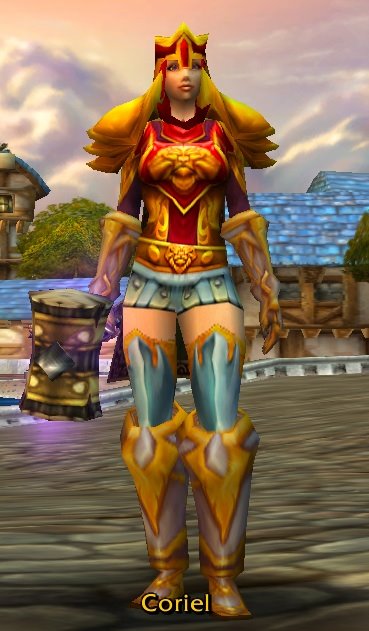
I picked up an [Earthshaker] in Molten Core today. I was kind of surprised I won it, as I was in the middle of the pack for DKP. I guess the other paladins are waiting for Lawbringer pieces.
I'm pondering respeccing to take advantage of the proc. As it's a stun, I could Judgement of Command for extra damage. However, I'm currently 30/21/0 for Blessing of Sanctuary and raid healing. If I kept Sanctuary (I'm the only paladin in the guild who has it), I could do something like 14/21/16. Or I could forget about Sanctuary and go for a more normal Holy/Retribution build.
(Another option is a Reckoning build, but I really dislike Reckoning.)
As well, I need to enchant it. I'm currently using a 1H and shield (non-epic) inside MC, but I could put +22 Int on the [Earthshaker] and use that as my primary raid weapon. I could also just forget about it in raids and put a combat enchant on it for farming or PvP.
Of course, I actually need gold to do any of this, so its all theoretical at this point. :)
Blizzard's Paladin Vision
After thinking about it for a while, I think that Blizzard intended for paladins to be in melee on raids. To heal and cleanse from melee range.
Proof: Lawbringer armor
Lawbringer is our Tier 1 set. The first armor we get from 40-man raid instances, armor specifically designed for us, and the armor that prepares us for what Blizzard thinks our should be our role in raid content.
So let's look at Lawbringer. It has +Int and +heal, which implies that we should be helping to heal. But it also has a bit of +Str which adds to our damage. As well, take a look at the set bonuses:
3 pieces: Increases the chance of triggering a Judgement of Light heal by 10%.
5 pieces: Improves your chance to get a critical strike with spells by 1%.
5 pieces: Improves your chance to get a critical strike by 1%.
8 pieces: Gives the Paladin a chance on every melee hit to heal your party for 189 to 211.
Three out of four bonuses only work if the paladin is meleeing!
Lawbringer is meant to help us fulfill our role in raiding. It has +Str and bonuses that reward the paladin for meleeing. It has +Int and +heal that reward the paladin for healing.
I believe that it is clear from Lawbringer armor that Blizzard intended us to melee in raids and heal from melee range.
This is their vision, and it is a good vision.
The problem is not with Blizzard, but with guilds who are too timid to let their paladins live up to the role that Blizzard intends for us.
Proof: Lawbringer armor
Lawbringer is our Tier 1 set. The first armor we get from 40-man raid instances, armor specifically designed for us, and the armor that prepares us for what Blizzard thinks our should be our role in raid content.
So let's look at Lawbringer. It has +Int and +heal, which implies that we should be helping to heal. But it also has a bit of +Str which adds to our damage. As well, take a look at the set bonuses:
3 pieces: Increases the chance of triggering a Judgement of Light heal by 10%.
5 pieces: Improves your chance to get a critical strike with spells by 1%.
5 pieces: Improves your chance to get a critical strike by 1%.
8 pieces: Gives the Paladin a chance on every melee hit to heal your party for 189 to 211.
Three out of four bonuses only work if the paladin is meleeing!
Lawbringer is meant to help us fulfill our role in raiding. It has +Str and bonuses that reward the paladin for meleeing. It has +Int and +heal that reward the paladin for healing.
I believe that it is clear from Lawbringer armor that Blizzard intended us to melee in raids and heal from melee range.
This is their vision, and it is a good vision.
The problem is not with Blizzard, but with guilds who are too timid to let their paladins live up to the role that Blizzard intends for us.
Wednesday, May 10, 2006

Monday, May 08, 2006
What I Miss...
You know what I, as a 60, miss the most from levels 1 to 59?
I miss the sound you get when you discover a new area and piece of the map fills in.
Such a nice sound. The sound probably doesn't play at 60 because it's tied to the experience gained for the discovery, and you no longer get experience at 60. It's a pity though. Hopefully it will return when the level cap goes up.
I miss the sound you get when you discover a new area and piece of the map fills in.
Such a nice sound. The sound probably doesn't play at 60 because it's tied to the experience gained for the discovery, and you no longer get experience at 60. It's a pity though. Hopefully it will return when the level cap goes up.
Sunday, May 07, 2006
Casuals vs. Raiders, Part IV
Continuing the eternal series, part of the problem between casuals vs raiders is that the gulf between them is only one-way. Casuals cannot do raid content. However, raiders can do casual content.
In fact, they will do such content if the rewards are half decent, or if they are simply bored. So there's no such thing as content specifically for casuals. And this feels a little bit unfair to casual players. After all, both groups are paying the same amount of money to Blizzard. Yet the raiders get new content which they don't share, but casuals have to share all their content. It's possibly a bit irrational, but that's the way we are.
I think WoW needs to address this asymmetry (in addition to making it easier to raid). My suggestion would be an epic 5-man dungeon. This dungeon would be hard and would drop unique loot slightly better than Tier 1, but less than Tier 2 (a Dungeon 3 set). The dungeon would be on a 7-day timer, like the raid instances, allowing a small group to work on the dungeon over the course of the week.
The kicker, though, is that if you were saved to this 5-man, you would be locked out of the 40-man raids for the week. And if you were saved to MC/BWL/etc., you'd be locked out of this epic 5-man.
So for raiders, this dungeon presents a real drawback. If you go to this dungeon, you can't raid with your guild that week. If you raid with your guild, you can't try this dungeon. However, for a casual player, there is effectively no drawback to trying this 5-man, as you aren't raiding anyways.
The key is giving the casuals an experience that the raiders can't easily share. Raiders still have the lion's share of endgame and loot. However, casuals get a toy for them, and them alone.
In fact, they will do such content if the rewards are half decent, or if they are simply bored. So there's no such thing as content specifically for casuals. And this feels a little bit unfair to casual players. After all, both groups are paying the same amount of money to Blizzard. Yet the raiders get new content which they don't share, but casuals have to share all their content. It's possibly a bit irrational, but that's the way we are.
I think WoW needs to address this asymmetry (in addition to making it easier to raid). My suggestion would be an epic 5-man dungeon. This dungeon would be hard and would drop unique loot slightly better than Tier 1, but less than Tier 2 (a Dungeon 3 set). The dungeon would be on a 7-day timer, like the raid instances, allowing a small group to work on the dungeon over the course of the week.
The kicker, though, is that if you were saved to this 5-man, you would be locked out of the 40-man raids for the week. And if you were saved to MC/BWL/etc., you'd be locked out of this epic 5-man.
So for raiders, this dungeon presents a real drawback. If you go to this dungeon, you can't raid with your guild that week. If you raid with your guild, you can't try this dungeon. However, for a casual player, there is effectively no drawback to trying this 5-man, as you aren't raiding anyways.
The key is giving the casuals an experience that the raiders can't easily share. Raiders still have the lion's share of endgame and loot. However, casuals get a toy for them, and them alone.
Saturday, May 06, 2006

Friday, May 05, 2006
Reckoning Idea
A while back, I posted about how I dislike the current incarnation of Reckoning. Here's an idea for a change to Reckoning to add a little interactivity, help tanking a bit, and add a little dps while soloing.
Make Reckoning trainable and change it to:
It's modeled after the warrior skill Overpower. You get critted, the button lights up, and you smack them back once. No charges or any other silliness.
So we get another button to press during combat, which makes soloing a little bit more interactive. It does Holy damage which helps with Righteous Fury and tanking. It's not usable if you aren't being attacked, so it doesn't really change us in raid situations. It's based on weapon damage, so it scales as well as emphasizes the melee aspect.
Then in the place of the current Reckoning talent, we could have:
Admittedly, you can't do Reckoning bombs in PvP anymore, but an instant attack for 100% Holy damage is still pretty sweet. I also think this is more in line with the original intent behind Reckoning.
Make Reckoning trainable and change it to:
Reckoning
5% of Base Mana
Instant, 5s cooldown, Requires Melee Weapon
Instantly counterattack the enemy, causing Holy damage equal to 50% of weapon damage. Only useable after being the victim of a critical strike.
It's modeled after the warrior skill Overpower. You get critted, the button lights up, and you smack them back once. No charges or any other silliness.
So we get another button to press during combat, which makes soloing a little bit more interactive. It does Holy damage which helps with Righteous Fury and tanking. It's not usable if you aren't being attacked, so it doesn't really change us in raid situations. It's based on weapon damage, so it scales as well as emphasizes the melee aspect.
Then in the place of the current Reckoning talent, we could have:
Improved Reckoning
Requires 20pts in Protection
Improves the damage done by Reckoning to 60%/70%/80%/90%/100% of weapon damage.
Admittedly, you can't do Reckoning bombs in PvP anymore, but an instant attack for 100% Holy damage is still pretty sweet. I also think this is more in line with the original intent behind Reckoning.
Tuesday, May 02, 2006
Baseline Spiritual Focus?
Blizzard has announced that in Patch 1.11, druids will be getting Innervate--previously the 31-pt Restoration talent--as a baseline trainable talent (and some sort of new 31-pt talent). I think this is a good move, as a lot of raiding guilds were making Innervate mandatory for their druids.
On the paladin boards, a lot of people are suggesting paladin talents that should become baseline. While things like Seal of Command, Consecrate, Kings, etc. would be nice, I'd like to propose a different talent becoming baseline:
Spiritual Focus.
(70% chance to avoid spell interruption from damage)
Why? Well, almost every build includes this talent, forcing paladins to go 10pts deep into Holy. Pure Protection/Retribution builds are extremely rare.
Secondly, we are meant to be melee fighters. Emphasizing that we can cast healing spells in melee combat reinforces that ideal. As well, priests have a similar talent, save that it is only 2 points and in the first tier. It's slightly disconcerting that priests are able to cast from melee better than paladins.
Spiritual Focus is as close to a must-have talent as there is for paladins. By replacing Spiritual Focus with a different, more unique 5pt talent in the second tier, we should see a greater variety in paladin builds, and more freedom in abstaining from the Holy tree.
For example, I would love to make a 0/32/19 1H+Shield 'porcupine' build that features both Holy Shield and Improved Retribution Aura. Such a build would be very interesting to try.
However, not having Spiritual Focus is a huge risk. Improved Concentration Aura only gives a 50% chance to avoid interruption, and the long cast time of Holy Light means there's a high chance of the spell being delayed. Spiritual Focus + Concentration Aura gives a 100% of avoiding interruption, which is essential as we are always in melee. A priest can fear, shield, cast an instant HoT, or cast a quick flash heal and avoid interruption in that manner.
On the paladin boards, a lot of people are suggesting paladin talents that should become baseline. While things like Seal of Command, Consecrate, Kings, etc. would be nice, I'd like to propose a different talent becoming baseline:
Spiritual Focus.
(70% chance to avoid spell interruption from damage)
Why? Well, almost every build includes this talent, forcing paladins to go 10pts deep into Holy. Pure Protection/Retribution builds are extremely rare.
Secondly, we are meant to be melee fighters. Emphasizing that we can cast healing spells in melee combat reinforces that ideal. As well, priests have a similar talent, save that it is only 2 points and in the first tier. It's slightly disconcerting that priests are able to cast from melee better than paladins.
Spiritual Focus is as close to a must-have talent as there is for paladins. By replacing Spiritual Focus with a different, more unique 5pt talent in the second tier, we should see a greater variety in paladin builds, and more freedom in abstaining from the Holy tree.
For example, I would love to make a 0/32/19 1H+Shield 'porcupine' build that features both Holy Shield and Improved Retribution Aura. Such a build would be very interesting to try.
However, not having Spiritual Focus is a huge risk. Improved Concentration Aura only gives a 50% chance to avoid interruption, and the long cast time of Holy Light means there's a high chance of the spell being delayed. Spiritual Focus + Concentration Aura gives a 100% of avoiding interruption, which is essential as we are always in melee. A priest can fear, shield, cast an instant HoT, or cast a quick flash heal and avoid interruption in that manner.
Monday, May 01, 2006
The Invisible Hand of Raiding
A lot of guilds restrict loot by class. They justify this with the phrase "Guild progress comes before personal progress."
As a counter, I offer these words:
Liberal capitalism is, in general, the dominant economic system in modern times. It's fundamental idea is that of the Invisible Hand: that an individual seeking to improve his own situation will unintentionally work for the benefit of the group. For the most part, the system works in real life.
The same philosophy should also work in WoW. A neutral system of earning and spending DKP should lead to people seeking to improve their characters as they want to, and thus unintentionally improving the raid. I have not yet seen a good reason why the Invisible Hand does not apply to WoW.
The argument against this is "a warrior will do more dps with Uber-2H-sword than a paladin on a raid." And this is strictly true. So how then does giving the paladin the Uber-2H-sword improve the raid? For one thing, the paladin will be less likely to quit. If you are prevented from improving your character as you want to, your enthusiasm wanes. If the paladin quits, the guild loses multiple epics and a skilled player. This is a bigger loss to the raid than a single weapon being used slightly less efficiently. It's generally taken as a given that healing classes, in addition to being the rarest, are the ones which burn out fastest. Keeping healers from burning out, at the cost of one or two dps epics going to a healer, improves the raid.
As well, people do other things than raids. They quest, farm and PvP. By making a rational decision to improve some of these other areas, they benefit the guild. As a personal example, I'm currently working on farming for my Hide of the Wild. I'm specced for raiding (30/21/0 - raid gets Blessing of Sanctuary), and thus farming is painfully slow. A good epic weapon would make farming easier, leading to a better healing cape which would improve the raid. In fact, farming is so painful--and I have to farm for some other enchants--that I am considering to switching to 20/0/31, which means no more Blessing of Sanctuary and worse healing on raids.
In the end, people are most productive when they are improving their character as they see fit. A raiding guild should think long and hard before abandoning the wisdom of Adam Smith.
As a counter, I offer these words:
"By pursuing his own interest he frequently promotes that of the society more effectually than when he really intends to promote it. I have never known much good done by those who affected to trade for the public good."
- Adam Smith, An Inquiry into the Nature and Causes of the Wealth of Nations, 1776
Liberal capitalism is, in general, the dominant economic system in modern times. It's fundamental idea is that of the Invisible Hand: that an individual seeking to improve his own situation will unintentionally work for the benefit of the group. For the most part, the system works in real life.
The same philosophy should also work in WoW. A neutral system of earning and spending DKP should lead to people seeking to improve their characters as they want to, and thus unintentionally improving the raid. I have not yet seen a good reason why the Invisible Hand does not apply to WoW.
The argument against this is "a warrior will do more dps with Uber-2H-sword than a paladin on a raid." And this is strictly true. So how then does giving the paladin the Uber-2H-sword improve the raid? For one thing, the paladin will be less likely to quit. If you are prevented from improving your character as you want to, your enthusiasm wanes. If the paladin quits, the guild loses multiple epics and a skilled player. This is a bigger loss to the raid than a single weapon being used slightly less efficiently. It's generally taken as a given that healing classes, in addition to being the rarest, are the ones which burn out fastest. Keeping healers from burning out, at the cost of one or two dps epics going to a healer, improves the raid.
As well, people do other things than raids. They quest, farm and PvP. By making a rational decision to improve some of these other areas, they benefit the guild. As a personal example, I'm currently working on farming for my Hide of the Wild. I'm specced for raiding (30/21/0 - raid gets Blessing of Sanctuary), and thus farming is painfully slow. A good epic weapon would make farming easier, leading to a better healing cape which would improve the raid. In fact, farming is so painful--and I have to farm for some other enchants--that I am considering to switching to 20/0/31, which means no more Blessing of Sanctuary and worse healing on raids.
In the end, people are most productive when they are improving their character as they see fit. A raiding guild should think long and hard before abandoning the wisdom of Adam Smith.
Thursday, April 27, 2006
Wishlist Loot System
In a post on the WoW Raid and Dungeon forums, Coracus of Infliction (Dragonmaw server) outlines his guild's rather unique loot system:
I find this is a very interesting endgame loot system. For one thing, I believe it is the first endgame system I've seen which is memory-less. I didn't think that this was possible or even desirable.
Secondly, it forces you to think about loot differently. Narrowing down to six items makes you think ahead, and think in terms of the larger picture. Also, you are no longer competing against everyone who can use an item, but only those who value it enough to be in the wishlist.
As well, everyone's wishlists are public, which means that you see the larger picture and goals of the entire guild. People's lists being public also allow you to meta-game, and choose items which are in less demand.
The overhead of this system is also extremely low. Tracking DKP for an entire guild can be time-consuming. This system is very easy on the officers. Additionally, wishlists are posted in advance, which allows officers some measure of time to detect and head off problems.
Of course, the system does have its flaws. For one thing, you cannot guarantee winning an item. It is entirely possible that someone will constantly lose rolls on a specific item, which may lead to feelings of unfairness. And it is probable that a raider with less time spent will occasionally beat a raider who raids a lot.
However, I think that overall this system is a very good one. For one thing, I think it promotes a healthier attitude towards loot and progression, and forces players to decide what is really valuable to them. The low overhead is a serious benefit, allowing officers to concentrate on more important things. I commend Infliction on their innovative system.
Wish list system:
Each person gets to put their most wanted 6 items on their wish list. You cannot change the wish list once you have made it. Items on the wish list can only be changed once either A) The item drops and you don't get it, or B) the item drops and you do get it.
The order of roll allowance goes as follows:
1. Wishlist (X class/DPS/Healers) please roll:
2. Need Guild Members please roll:
3. If no one Needs, then Shard
If the person on the wish list decides to pass it, then can give up their roll to another person on the wish list. They cannot just pass it to any person, you can only give up a roll. Meaning it goes to open roll if no one has it on their wish list.
I find this system works very well with a close group of raiders. It's been much more enjoyable than DKP, and we've used it right through Nefarian.
Why I dislike DKP, is it adds to that feeling we constantly have about "Grinding". You have to grind dkp just to bid on items. In our guild, we all know the loot will come as long as everyone shows up on time and raids. The wishlist system lets you concentrate on having a good time and knowing you always have a chance to roll on the items you want,instead of thinking "well every other person has X dkp, so ill never get anything".
I find this is a very interesting endgame loot system. For one thing, I believe it is the first endgame system I've seen which is memory-less. I didn't think that this was possible or even desirable.
Secondly, it forces you to think about loot differently. Narrowing down to six items makes you think ahead, and think in terms of the larger picture. Also, you are no longer competing against everyone who can use an item, but only those who value it enough to be in the wishlist.
As well, everyone's wishlists are public, which means that you see the larger picture and goals of the entire guild. People's lists being public also allow you to meta-game, and choose items which are in less demand.
The overhead of this system is also extremely low. Tracking DKP for an entire guild can be time-consuming. This system is very easy on the officers. Additionally, wishlists are posted in advance, which allows officers some measure of time to detect and head off problems.
Of course, the system does have its flaws. For one thing, you cannot guarantee winning an item. It is entirely possible that someone will constantly lose rolls on a specific item, which may lead to feelings of unfairness. And it is probable that a raider with less time spent will occasionally beat a raider who raids a lot.
However, I think that overall this system is a very good one. For one thing, I think it promotes a healthier attitude towards loot and progression, and forces players to decide what is really valuable to them. The low overhead is a serious benefit, allowing officers to concentrate on more important things. I commend Infliction on their innovative system.
Wednesday, April 26, 2006
People Afraid To Try
There's one type of person in Wow who really get on my nerves. Basically, these are the types of people who actively speak out against trying something if the raid or group doesn't have the 'optimum' makeup.
For example, our guild was at Garr in Molten Core the other night. Garr has 8 adds. The 'normal' strategy is to tank four of the adds and Banish the other four. However, we only had 2 warlocks to banish. We did have 6 or 7 warriors and a strong amount of healing, so the fight was possible with a change of strategy. However, one player spoke up and declared that the fight was 'impossible' without the extra warlocks, and we shouldn't even try.
This timidity is the one thing that really bugs me in WoW. Why not try? The worst that happens is we wipe, and we count that as a lesson learned.
The next week, we had enough warlocks to do the fight normally, and we killed Garr. Thinking about continuing on to Baron Geddon, that same player says that we don't have enough Fire Resistance in the raid to continue. Argh! [1]
If we tried, wiped, and then came to the conclusion that we needed more Fire Resistance, that would one thing. But to be unwilling to even try?
You see this even in lower instances. People who won't do anything if the group makeup is not exactly correct according to perceived wisdom. Or maybe certain people have the wrong talents (Feral vs Resto druids, Shadow vs Holy priests, etc.).
It's odd, but whenever I've grouped with people from the very elite, cutting-edge guilds, they don't seem to adhere to this 'common wisdom'. Maybe it's because what I'm working on is trivial to them, but they seem to be more willing to try less conventional solutions.
[1] I do have to say that the player in question is a very good, solid player. I just wish he'd be a bit more willing or enthusiastic about taking risks.
For example, our guild was at Garr in Molten Core the other night. Garr has 8 adds. The 'normal' strategy is to tank four of the adds and Banish the other four. However, we only had 2 warlocks to banish. We did have 6 or 7 warriors and a strong amount of healing, so the fight was possible with a change of strategy. However, one player spoke up and declared that the fight was 'impossible' without the extra warlocks, and we shouldn't even try.
This timidity is the one thing that really bugs me in WoW. Why not try? The worst that happens is we wipe, and we count that as a lesson learned.
The next week, we had enough warlocks to do the fight normally, and we killed Garr. Thinking about continuing on to Baron Geddon, that same player says that we don't have enough Fire Resistance in the raid to continue. Argh! [1]
If we tried, wiped, and then came to the conclusion that we needed more Fire Resistance, that would one thing. But to be unwilling to even try?
You see this even in lower instances. People who won't do anything if the group makeup is not exactly correct according to perceived wisdom. Or maybe certain people have the wrong talents (Feral vs Resto druids, Shadow vs Holy priests, etc.).
It's odd, but whenever I've grouped with people from the very elite, cutting-edge guilds, they don't seem to adhere to this 'common wisdom'. Maybe it's because what I'm working on is trivial to them, but they seem to be more willing to try less conventional solutions.
[1] I do have to say that the player in question is a very good, solid player. I just wish he'd be a bit more willing or enthusiastic about taking risks.
Saturday, April 22, 2006
The 'Men In Tights' Problem
If you wander across the blogs of MMO game devs, you see a lot of reference to the 'men in tights' problem. The vast majority of MMOs are fantasy games. SirBruce, of www.mmogchart.com, estimates that 89% of all MMOs are fantasy-based. So it's a pressing question (for game devs, anyway) of why this is so, and does a non-fantasy game have a chance of succeeding.
There are a lot of explanations proposed, from the fact that our culture is steeped in the past, or that the first MMOs were fantasy, so that's the way it is. I think there is a different reason that most games are fantasy. The fundamental conceit of rpgs is that:
As I do stuff, I become harder to defeat.
In fantasy games, you have all sorts of explanations for this, from magical healing, to better armor, to better skill with weapons, to just being physically tougher than the other guy. Levelling up represents becoming tougher and better skilled. In a swordfight, we expect the more skilled fighter to come out alive. And a lot of the attraction of RPGs relies on this: our working on a character and slowly making them more and more powerful.
However, as you introduce technology, it becomes a lot harder to justify this basic idea. The entire point of technology, in a lot of ways, is to replace skill. There is an old saying, popular in the eighteenth century, that "God made all men, but Sam Colt made them equal." This saying perfectly encapsulates the point that technology makes the unskilled deadlier. Non-fantasy games need to be able to account for this. If you have a game where a character can get shot with a gun at point-blank range and almost always survive, that's really hard to take.
Now, that's not to say that non-fantasy games can't do this. Take Eve Online. Eve Online is pretty much as non-fantasy as you get. Eve Online, however, replaces "I" with "my ship". It makes sense that a better, more expensive and technologically advanced ship is harder to defeat. That fits in with our worldview. And thus Eve works as an MMO, where "levelling" involves improving your ship.
However, it's easier for a fantasy game to account for this. And this is the main reason, I think, that fantasy is the most popular genre. The levelling idea, of character improvement making survival more likely, fits fantasy better than any other genre.
There are a lot of explanations proposed, from the fact that our culture is steeped in the past, or that the first MMOs were fantasy, so that's the way it is. I think there is a different reason that most games are fantasy. The fundamental conceit of rpgs is that:
As I do stuff, I become harder to defeat.
In fantasy games, you have all sorts of explanations for this, from magical healing, to better armor, to better skill with weapons, to just being physically tougher than the other guy. Levelling up represents becoming tougher and better skilled. In a swordfight, we expect the more skilled fighter to come out alive. And a lot of the attraction of RPGs relies on this: our working on a character and slowly making them more and more powerful.
However, as you introduce technology, it becomes a lot harder to justify this basic idea. The entire point of technology, in a lot of ways, is to replace skill. There is an old saying, popular in the eighteenth century, that "God made all men, but Sam Colt made them equal." This saying perfectly encapsulates the point that technology makes the unskilled deadlier. Non-fantasy games need to be able to account for this. If you have a game where a character can get shot with a gun at point-blank range and almost always survive, that's really hard to take.
Now, that's not to say that non-fantasy games can't do this. Take Eve Online. Eve Online is pretty much as non-fantasy as you get. Eve Online, however, replaces "I" with "my ship". It makes sense that a better, more expensive and technologically advanced ship is harder to defeat. That fits in with our worldview. And thus Eve works as an MMO, where "levelling" involves improving your ship.
However, it's easier for a fantasy game to account for this. And this is the main reason, I think, that fantasy is the most popular genre. The levelling idea, of character improvement making survival more likely, fits fantasy better than any other genre.
Team and Individual Skill in PvP
In the comments to my last post on PvP, Thoma writes:
This isn't quite what I'm assuming (though if you amend it to *average* player skill, it is correct). I'm assuming that team skill is equal to the sum of the individual players skills.
Is this a good assumption for WoW Battlegrounds? I think it is. For example, if Alice and Beth beat Joe and Harry, but Beth and Carol lose to Joe and Harry, we can infer that Alice is more skilled than Carol. That seems like a reasonable result to me.
Now, there are other games where this assumption does not hold. For example, you could have a game where team skill is equal to the skill of the worst player. Is this a good model for BGs? I do not think so, because it implies that a team with 14 people will always lose to a team of 15 people. (The missing person is essentially a player with zero skill.) And this is not true for BGs. A team with 14 people is at a disadvantage, but the skill of the remaining players can make up for it. So this model is not good.
How about the opposite model? Is team skill equal to the skill of the best player in the Battleground? Again, I don't think this model holds, because it would imply that in a 1v15 match, if the one person was slightly better than each player on the 15-man team, she would win. And I don't think this is true in BGs. The most likely result is that the one person is going to lose, regardless of her skill.
So I think it's pretty clear that team skill in BGs is some combination of the skills of the individual players. And that means that we can infer individual skill by looking at how different teams with that individual perform. Which is what a system like TrueSkill™ does.
Is this model 100% accurate? No. For one thing we occasionally see teams which are greater or less than the sum of their individual parts. A classic example is the 2004 USA Olympic Men's Basketball Team. But for the most part, the model is pretty accurate, especially when players change teams reasonably often, as is the case with WoW Battlegrounds.
As an aside, I think a more accurate model of team skill would be to say that each pair of players on a team has a bond, and that bond may have some skill, positive or negative, associated with it. Two players may play especially well with each other, or two players may play poorly with each other. Then team skill becomes the sum of the skill of the individual players plus the sum of the skill of all bonds formed. In graph theory terms, under the first model only the vertices in a team have weights, but in the second model, some of the weight of the vertices shifts to the edges in the graph.
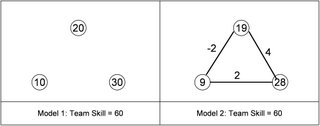
And individual skill in my first model is not just individual skill, but individual skill plus the sum of the skills in all bonds with that player multiplied by the probability of each bond occurring. But the first model, where only the vertices have weight, is a *lot* easier to deal with, and is probably accurate enough for the purpose of PvP ranks.
Again, it all comes down to you assuming that team skill/number of players = player skill.
This isn't quite what I'm assuming (though if you amend it to *average* player skill, it is correct). I'm assuming that team skill is equal to the sum of the individual players skills.
Is this a good assumption for WoW Battlegrounds? I think it is. For example, if Alice and Beth beat Joe and Harry, but Beth and Carol lose to Joe and Harry, we can infer that Alice is more skilled than Carol. That seems like a reasonable result to me.
Now, there are other games where this assumption does not hold. For example, you could have a game where team skill is equal to the skill of the worst player. Is this a good model for BGs? I do not think so, because it implies that a team with 14 people will always lose to a team of 15 people. (The missing person is essentially a player with zero skill.) And this is not true for BGs. A team with 14 people is at a disadvantage, but the skill of the remaining players can make up for it. So this model is not good.
How about the opposite model? Is team skill equal to the skill of the best player in the Battleground? Again, I don't think this model holds, because it would imply that in a 1v15 match, if the one person was slightly better than each player on the 15-man team, she would win. And I don't think this is true in BGs. The most likely result is that the one person is going to lose, regardless of her skill.
So I think it's pretty clear that team skill in BGs is some combination of the skills of the individual players. And that means that we can infer individual skill by looking at how different teams with that individual perform. Which is what a system like TrueSkill™ does.
Is this model 100% accurate? No. For one thing we occasionally see teams which are greater or less than the sum of their individual parts. A classic example is the 2004 USA Olympic Men's Basketball Team. But for the most part, the model is pretty accurate, especially when players change teams reasonably often, as is the case with WoW Battlegrounds.
As an aside, I think a more accurate model of team skill would be to say that each pair of players on a team has a bond, and that bond may have some skill, positive or negative, associated with it. Two players may play especially well with each other, or two players may play poorly with each other. Then team skill becomes the sum of the skill of the individual players plus the sum of the skill of all bonds formed. In graph theory terms, under the first model only the vertices in a team have weights, but in the second model, some of the weight of the vertices shifts to the edges in the graph.
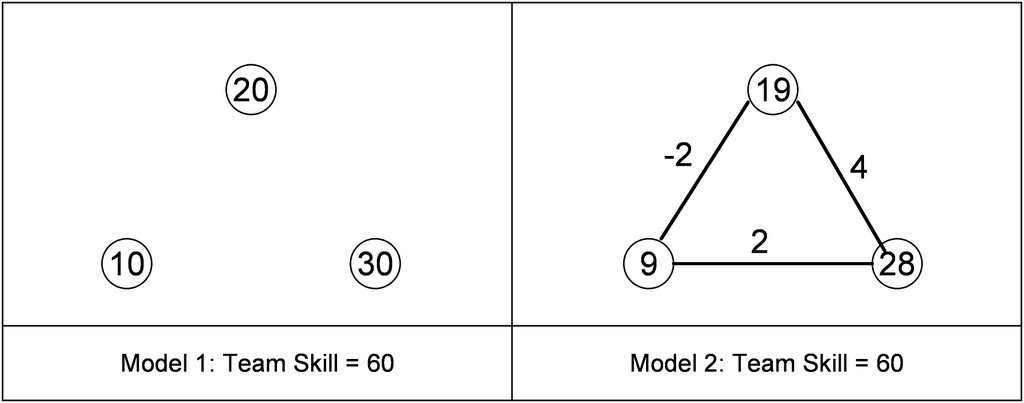
And individual skill in my first model is not just individual skill, but individual skill plus the sum of the skills in all bonds with that player multiplied by the probability of each bond occurring. But the first model, where only the vertices have weight, is a *lot* easier to deal with, and is probably accurate enough for the purpose of PvP ranks.
Wednesday, April 19, 2006
Don't Anger the Kodo!
I'm thinking about some of Thoma's points in the PvP thread, and hopefully will post a response soon. But in the meantime, here's a fun World PvP story that happened today:
My Forsaken warlock alt was questing in Desolace. At one point, I run into a Nightelf hunter and a Human mage, both of them around my level. I didn't really want to fight, especially outnumbered, as I just wanted to get to the town and hand in a quest before logging off. So I wave to them, hoping they'll let me go.
No such luck. They back up and start attacking. My succubus Seduces the hunter, and I start casting spells at the mage. I'm pretty sure I'm going to lose the fight eventually, when the mage runs in and starts casting Arcane Explosions.
Unfortunately for him, his Arcane Explosion hits a nearby herd of kodo. Enraged, the kodo charge over and promptly stomp him. Then they go and crush his hunter buddy, before wandering off.
So, the moral of the story:
My Forsaken warlock alt was questing in Desolace. At one point, I run into a Nightelf hunter and a Human mage, both of them around my level. I didn't really want to fight, especially outnumbered, as I just wanted to get to the town and hand in a quest before logging off. So I wave to them, hoping they'll let me go.
No such luck. They back up and start attacking. My succubus Seduces the hunter, and I start casting spells at the mage. I'm pretty sure I'm going to lose the fight eventually, when the mage runs in and starts casting Arcane Explosions.
Unfortunately for him, his Arcane Explosion hits a nearby herd of kodo. Enraged, the kodo charge over and promptly stomp him. Then they go and crush his hunter buddy, before wandering off.
So, the moral of the story:
- Focus Fire.
- Don't Anger the Kodo!
Monday, April 17, 2006
Comments on PvP System
Thoma points out some issues with my proposed system, and I've decided to make my responses into a full post, to expand upon my idea.
No, because a loss means your rating goes down. That's the difference between now and then. When you go afk, you basically have a 50% chance to go up and down, which becomes less than 50% because your team is effectively outnumbered.
To go afk and gain in rating implies you were on a succession of teams that consistantly won, even though they were a man down. That seems improbable, at the very least. If it was an organized team, the leader should recognize that you aren't contributing and boot you.
The reason botting works now is that there is no risk to just sitting and collecting HKs. In the current system, if you spend the entire match fishing, you will end up better than you started. Guaranteed.
Perhaps. It won't be a gank fest though. It will return world PvP to the same state as before the honor system (and to be honest, roughly the same state it is now, at least from my latest experiences on a PvP server). As well, each goal would only be achieveable once per week, hopefully minimizing the disruption.
The real gankfest was when we had the Honor system but no BGs. That was a terrible time. I was in the high 40s on a PvP server, within range of the 60s. It was supremely unfun. It's why I have a character on a PvE server now.
My system has no rewards for killing individual players, only for achieving goals, so people will only gank for the old reasons of boredom, opportunity, malice, and fun.
Yeah, to be able to separate in skill implies sufficient numbers. This is probably not possible for most servers at the moment. However, Blizzard is working on cross-server BGs, and it would be a good solution then.
As to high ranks, the players closest in rating play each other. If there were only two teams, they would play each other, even if there was a great difference in average rating. However, the better team would only increase rating by a tiny amount if they won, and the losing team would only lose a tiny amount. However, if the weaker team won, there would be a larger gain/loss.
It's basically the same system--in principle--as the ELO chess rating system, or Microsoft's Trueskill™ system.
1. Skill isn't rewarded, just wins/losses. Being AFK is even more rewarded under your system then the current system. Since all honor gained is win/loss rather then a mix of win/loss/HKs then you just turn AV into a bot farm.
No, because a loss means your rating goes down. That's the difference between now and then. When you go afk, you basically have a 50% chance to go up and down, which becomes less than 50% because your team is effectively outnumbered.
To go afk and gain in rating implies you were on a succession of teams that consistantly won, even though they were a man down. That seems improbable, at the very least. If it was an organized team, the leader should recognize that you aren't contributing and boot you.
The reason botting works now is that there is no risk to just sitting and collecting HKs. In the current system, if you spend the entire match fishing, you will end up better than you started. Guaranteed.
2. The stake to the heart you propose world pvp is going to really marginalize the PVP servers. It just makes it into Gank fests that don't end due to diminishing returns.
Perhaps. It won't be a gank fest though. It will return world PvP to the same state as before the honor system (and to be honest, roughly the same state it is now, at least from my latest experiences on a PvP server). As well, each goal would only be achieveable once per week, hopefully minimizing the disruption.
The real gankfest was when we had the Honor system but no BGs. That was a terrible time. I was in the high 40s on a PvP server, within range of the 60s. It was supremely unfun. It's why I have a character on a PvE server now.
My system has no rewards for killing individual players, only for achieving goals, so people will only gank for the old reasons of boredom, opportunity, malice, and fun.
3. You assume that all servers have enough PVP to make seperating out "skill groups" worth while. And what happens to the Grand Marshals? Do they only face each other? Or do you have to wait for 40 of each groups high ranks get together for an AV?
Yeah, to be able to separate in skill implies sufficient numbers. This is probably not possible for most servers at the moment. However, Blizzard is working on cross-server BGs, and it would be a good solution then.
As to high ranks, the players closest in rating play each other. If there were only two teams, they would play each other, even if there was a great difference in average rating. However, the better team would only increase rating by a tiny amount if they won, and the losing team would only lose a tiny amount. However, if the weaker team won, there would be a larger gain/loss.
It's basically the same system--in principle--as the ELO chess rating system, or Microsoft's Trueskill™ system.
Sunday, April 16, 2006
PvP, Skill, and the Honor System, Part II
Before we get to my idea for the honor system that rewards skill instead of time, we should define what skill is. In my view:
Skill is the ability to defeat an opponent in a fair fight.
Seems logical. If two characters fight each other, the more skilled player should win most of the time (all other things being equal).
The hard part, in World of Warcraft, comes with finding a fair fight. If a level 50 is attacked by a level 60, is that a fair fight? If a level 60 is attacked by 2 level 55s, is that a fair fight? What about if a character is fighting a mob, and another character jumps him? What if the character fighting the mob is higher level than the attacker?
Also, when does a fight end? In the zerg at Tarren Mill, how do you tell when one side wins? Is each individual death the end of a fight, or does it matter if one side pushes the other side back?
If you look at all the possibilities, it seems very hard to actually determine if a fight was fair or not, especially in world PvP. However, if we can see that Battlegrounds are reasonably fair. Both sides start with roughly equal numbers, level, and position. There is no interference from outside. There is a defined starting point and ending point. For the most part, the team that wins the Battleground is more skilled than the side that loses.
So my proposal is to make honor dependent on performance in Battlegrounds.
The basic idea is that each character has a PvP rating, like a chess rating. When a character's team wins a Battleground, her rating goes up proportional to the combined rating of the opposing team. If she win a victory against a good team, her rating increases more. If she loses, her rating goes down.
Then rating determines how fast you progress through the ranks, and what the maximum rank you can attain is. Each week, during Tuesday maintence, your increase in rank based on rating is applied. You would need to play a certain number of matches in the week (say 3) to be eligible for a change in rank. A person who has an average rating might only be able to reach Rank 5 (and take 8 weeks to get there). A person one standard deviation higher might reach Rank 8 in the same time. Rank 14 would need a *very* high rating (three or four standard deviations, probably).
There are a lot of benefits to this proposal. First, ratings are an intuitively simple idea. Everyone understands them. If a Grand Marshal is someone who wins all the time, that just makes sense. Second, since your rating changes with each game, you don't need to play a great many games. However, you need to win in the games you do play.
Third, since ratings depends on victory rather than kills, it also rewards players who play for the victory. People who heal, who play defense, who use strategy and tactics. Leadership becomes a valuable asset, as leadership leads to victory. Right now, I find that a lot of Rank 13/14s aren't really leaders, but loners who just rack up kills.
Fourth, since you now have ratings, you could match players by skill level. The game could match players of equal skill level. Higher rated players get to play other higher rated players.
Now, there are some negatives to this proposal. People who solo and join pickup groups will be at a disadvantage compared to people who run in teams. Matching using rating could moderate this a bit.
The biggest downside though, is that it will completely kill world PvP. World PvP just does not fit into the rating system. You simply cannot guarantee the "fair fight" that the rating system depends on.
The only idea I have to encourage world PvP is to have faction-wide goals. For example, if one of the six Race leaders (Thrall, Magni, etc.) is killed, everyone in the enemy faction gains an extra quarter-rank on Tuesday, and everyone in the friendly faction loses a quarter-rank. By making the gain or loss faction-wide, there is extreme incentive on both sides to help. Otherwise, how would you know which defenders to penalize? Making it zero-sum ensures that people don't simply trade leaders. As well, it may promote larger strategies like having one raid feint at one leader while another raid goes after a different leader.
Perhaps there could be other goals. Maybe each small town (Southshore, Tarren Mill, etc.) could have a flag like the nodes in Arathi Basin. If a flag is held by the opposing side for a full 24 hours, the town is declared "defeated" for the week and everyone gains and loses 10% of a rank on Tuesday. (Nothing changes in town other than the flag, all npcs and quests would stay the same.)
However, even if something like the world goals is not implemented, I think that performance in the Battlegrounds should be the primary determiner of skill and rank. It is as close to a fair fight as you will find in WoW, and is a much better and simpler measure of skill than the current system.
Skill is the ability to defeat an opponent in a fair fight.
Seems logical. If two characters fight each other, the more skilled player should win most of the time (all other things being equal).
The hard part, in World of Warcraft, comes with finding a fair fight. If a level 50 is attacked by a level 60, is that a fair fight? If a level 60 is attacked by 2 level 55s, is that a fair fight? What about if a character is fighting a mob, and another character jumps him? What if the character fighting the mob is higher level than the attacker?
Also, when does a fight end? In the zerg at Tarren Mill, how do you tell when one side wins? Is each individual death the end of a fight, or does it matter if one side pushes the other side back?
If you look at all the possibilities, it seems very hard to actually determine if a fight was fair or not, especially in world PvP. However, if we can see that Battlegrounds are reasonably fair. Both sides start with roughly equal numbers, level, and position. There is no interference from outside. There is a defined starting point and ending point. For the most part, the team that wins the Battleground is more skilled than the side that loses.
So my proposal is to make honor dependent on performance in Battlegrounds.
The basic idea is that each character has a PvP rating, like a chess rating. When a character's team wins a Battleground, her rating goes up proportional to the combined rating of the opposing team. If she win a victory against a good team, her rating increases more. If she loses, her rating goes down.
Then rating determines how fast you progress through the ranks, and what the maximum rank you can attain is. Each week, during Tuesday maintence, your increase in rank based on rating is applied. You would need to play a certain number of matches in the week (say 3) to be eligible for a change in rank. A person who has an average rating might only be able to reach Rank 5 (and take 8 weeks to get there). A person one standard deviation higher might reach Rank 8 in the same time. Rank 14 would need a *very* high rating (three or four standard deviations, probably).
There are a lot of benefits to this proposal. First, ratings are an intuitively simple idea. Everyone understands them. If a Grand Marshal is someone who wins all the time, that just makes sense. Second, since your rating changes with each game, you don't need to play a great many games. However, you need to win in the games you do play.
Third, since ratings depends on victory rather than kills, it also rewards players who play for the victory. People who heal, who play defense, who use strategy and tactics. Leadership becomes a valuable asset, as leadership leads to victory. Right now, I find that a lot of Rank 13/14s aren't really leaders, but loners who just rack up kills.
Fourth, since you now have ratings, you could match players by skill level. The game could match players of equal skill level. Higher rated players get to play other higher rated players.
Now, there are some negatives to this proposal. People who solo and join pickup groups will be at a disadvantage compared to people who run in teams. Matching using rating could moderate this a bit.
The biggest downside though, is that it will completely kill world PvP. World PvP just does not fit into the rating system. You simply cannot guarantee the "fair fight" that the rating system depends on.
The only idea I have to encourage world PvP is to have faction-wide goals. For example, if one of the six Race leaders (Thrall, Magni, etc.) is killed, everyone in the enemy faction gains an extra quarter-rank on Tuesday, and everyone in the friendly faction loses a quarter-rank. By making the gain or loss faction-wide, there is extreme incentive on both sides to help. Otherwise, how would you know which defenders to penalize? Making it zero-sum ensures that people don't simply trade leaders. As well, it may promote larger strategies like having one raid feint at one leader while another raid goes after a different leader.
Perhaps there could be other goals. Maybe each small town (Southshore, Tarren Mill, etc.) could have a flag like the nodes in Arathi Basin. If a flag is held by the opposing side for a full 24 hours, the town is declared "defeated" for the week and everyone gains and loses 10% of a rank on Tuesday. (Nothing changes in town other than the flag, all npcs and quests would stay the same.)
However, even if something like the world goals is not implemented, I think that performance in the Battlegrounds should be the primary determiner of skill and rank. It is as close to a fair fight as you will find in WoW, and is a much better and simpler measure of skill than the current system.
Saturday, April 15, 2006
PvP, Skill, and the Honor System, Part I
The Honor System in World of Warcraft is fundamentally flawed. Most people expect the Honor system to measure skill in PvP, and it really does not. A Grand Marshal or High Warlord should be the most skilled fighters on the server, and often they are not. The flaw in the Honor System can be summed up as follows (Coriel's First Law of Skill):
If the metric used to measure skill cannot decrease, you are not measuring skill, but time.
Intuitively, this idea is pretty clear. In most other games, your skill metric can go down as easily as it goes up. Consider poker, where you can measure skill with money won. A good player wins more money than an bad player. In fact, a bad player often loses money. And this possibility to win or lose money occurs on every hand. If you could never lose money in poker, the person with the most money would be the person who could play the longest.
Another example is the batting average in baseball. You get a hit, your batting average goes up. You strike out, your batting average goes down. Or how about chess? You win a match, your rating goes up. You lose a match, your rating goes down.
Pretty much every game other than WoW gets this. Yet in WoW's PvP system, your honor total cannot decrease. If you go into a Battleground, or attack another player, you will never end up worse than when you started. And so the people who gain rank are the ones who play the most, not necessarily the most skilled players.
Now, there are all sorts of potential ways to change the metric so it more truely measures skill. For example, you could do Kills minus Deaths. Or Kills per Death. Or Kills per unit time played. Or some sort of rating system, where if you are defeated, your rating goes down proportionally to the rating of the one who killed you. The important thing is that each PvP encounter must be a risk, that your honor should have the potential to decrease as well as simply increase.
Of course, being a random anonymous internet pundit, I have a preferred alternative to the current Honor System. That will be the subject of Part II.
If the metric used to measure skill cannot decrease, you are not measuring skill, but time.
Intuitively, this idea is pretty clear. In most other games, your skill metric can go down as easily as it goes up. Consider poker, where you can measure skill with money won. A good player wins more money than an bad player. In fact, a bad player often loses money. And this possibility to win or lose money occurs on every hand. If you could never lose money in poker, the person with the most money would be the person who could play the longest.
Another example is the batting average in baseball. You get a hit, your batting average goes up. You strike out, your batting average goes down. Or how about chess? You win a match, your rating goes up. You lose a match, your rating goes down.
Pretty much every game other than WoW gets this. Yet in WoW's PvP system, your honor total cannot decrease. If you go into a Battleground, or attack another player, you will never end up worse than when you started. And so the people who gain rank are the ones who play the most, not necessarily the most skilled players.
Now, there are all sorts of potential ways to change the metric so it more truely measures skill. For example, you could do Kills minus Deaths. Or Kills per Death. Or Kills per unit time played. Or some sort of rating system, where if you are defeated, your rating goes down proportionally to the rating of the one who killed you. The important thing is that each PvP encounter must be a risk, that your honor should have the potential to decrease as well as simply increase.
Of course, being a random anonymous internet pundit, I have a preferred alternative to the current Honor System. That will be the subject of Part II.
Wednesday, April 12, 2006
Epic Charger!
At long last, I finished the paladin epic charger quest. I've had this quest for so long, and failed it so many times. After a while, I just stopped attempting it.
Today I joined a guild group trying the quest and we rocked Scholomance. We had one heart-stopping moment during the 3rd wave of spirits when three people died. Luckily we got some space and were able to resurrect them.
Then we faced Death Knight Darkreaver. I used my Holy Mightstone, which I had been saving for this day for months, and we just destroyed him!
Awesome, awesome day!
Tuesday, April 11, 2006
Guild Philosophy
I joined another raiding guild in the end. This guild is less hardcore than my previous guild, and I find it suits me a bit better. For one thing they let the paladins melee in Molten Core!
(Honestly, I think the leadership is new to raiding in general, and don't realize that most guilds believe paladins are supposed to stay at the back. And we paladins are not enlightening them. :) )
Getting to melee makes Molten Core so much more fun! I find healing and cleansing can easily be done from the front lines. There are times when it's better to stay back (for example, when I need to help keep the main tank up), but the guild leaves the choice up to the individual paladin. This is actually quite liberating. I find that having the option to melee makes the game more fun, even if I choose not to take it.
Now, I'm not sure that paladins meleeing is the absolute optimal strategy. We are only on Gehennas. However, we have problems getting more than 30 people in the raid, and we did take down Magmadar for the first time with only 33 people. That seems like a pretty good accomplishment, so I'm willing to reserve judgement. And I'm having a lot more fun, so that has to count for something.
In all honesty, I think a lot of the problems at the raid level, from loot issues to class behaviour stem from the arrogance of some raiders. A lot of them believe that they know how to play your character better than you do. That's why they impose restrictions on you and on themselves. They do not trust you to make the correct decisions for your character, and so they try to make the decisions for you.
A good guild, in my opinion, needs to adopt the view that: The person who can best play your character is you. In the end, it all comes down to trust. If you trust that your people know how to play, you trust that they will only take loot they will use well.
There's a quote I've always liked. It's possibly a bit extreme for something as mundane as guilds in an MMO, but for what it's worth:
(Honestly, I think the leadership is new to raiding in general, and don't realize that most guilds believe paladins are supposed to stay at the back. And we paladins are not enlightening them. :) )
Getting to melee makes Molten Core so much more fun! I find healing and cleansing can easily be done from the front lines. There are times when it's better to stay back (for example, when I need to help keep the main tank up), but the guild leaves the choice up to the individual paladin. This is actually quite liberating. I find that having the option to melee makes the game more fun, even if I choose not to take it.
Now, I'm not sure that paladins meleeing is the absolute optimal strategy. We are only on Gehennas. However, we have problems getting more than 30 people in the raid, and we did take down Magmadar for the first time with only 33 people. That seems like a pretty good accomplishment, so I'm willing to reserve judgement. And I'm having a lot more fun, so that has to count for something.
In all honesty, I think a lot of the problems at the raid level, from loot issues to class behaviour stem from the arrogance of some raiders. A lot of them believe that they know how to play your character better than you do. That's why they impose restrictions on you and on themselves. They do not trust you to make the correct decisions for your character, and so they try to make the decisions for you.
A good guild, in my opinion, needs to adopt the view that: The person who can best play your character is you. In the end, it all comes down to trust. If you trust that your people know how to play, you trust that they will only take loot they will use well.
There's a quote I've always liked. It's possibly a bit extreme for something as mundane as guilds in an MMO, but for what it's worth:
"You? I know you! You trust beyond reason."
She met his eyes steadily. "Yes. It's how I get results beyond hope.'"
- A Civil Campaign, Lois McMaster Bujold
Monday, April 03, 2006
Paladins in PvP
Paladins in PvP is a very complicated topic. Paladins are deeply flawed in PvP combat, but in many ways the flaw is not with the paladin, but rather with the surrounding structure.
I believe that a skilled paladin has a good chance against every other class in one-on-one combat (except warlocks, no one can beat warlocks). This is especially true if the paladin plays to her strengths. The best strategy for a paladin is to be a rock, and let your opponents break themselves on you.
Let me illustrate this with my strategy for fighting mages:
Anyways, following this strategy I can usually beat an equally-geared mage more than half the time. Occasionally the mage will get a string of crits and blow you away, but it's a reasonable fight.
The problem, however, is that the fight takes three to four minutes. All paladin fights take a long time. All the other classes kill quickly or are quickly killed. The paladin's strength is her survivability and ability to outlast her opposition. Unfortunately, the way the Honor System and Battlegrounds are implemented really hurt the paladin.
The Honor System rewards those classes which can get a lot of kills. Since there is no penalty for dying, a character who can kill someone really fast is at an advantage over someone who kills slowly. Every class can spec for high DPS except the paladin. So every class can rack up honor faster than the paladin.
The other problem is that a paladin has high survivability, but low DPS. However, the paladin's survivability drops dramatically if faced with superior numbers. For example, if I am guarding a node in Arathi Basin by myself, and one Horde player comes by, I can draw out the fight for a very long time (several minutes if need be). Long enough for reinforcements to arrive. However, if two Horde players come by, I will die *very* quickly. I will die just as fast as any other class would. The extra survivability does not help in that case.
(The exception to the above is if I have the bubble up. Then I can stall for 12 seconds, and then die immediately after.)
So the number of times that paladin survivability actually plays a role is a lot lower than it appears. In my view, it only makes a difference in equal number fights, which are fairly rare.
The implementation of Battlegrounds also hurts the paladin. Survivability means that you do not die easily. But what happens if you do die? You are kept out of the battle for an average of 15s. This is a very short time when you consider how long it takes a paladin to kill someone. The penalty for dying is very low and this devalues the effect of survivability. Dying a lot is okay if you can kill a lot before you go. I suspect that if the resurrection timers were increased from 30 seconds to 2 minutes (giving an average time dead of 1 minute), paladins would become much more powerful in PvP.
Battlegrounds are designed for the high DPS style of the other classes, and thus the low DPS style of paladins is disadvantaged.
I believe that a skilled paladin has a good chance against every other class in one-on-one combat (except warlocks, no one can beat warlocks). This is especially true if the paladin plays to her strengths. The best strategy for a paladin is to be a rock, and let your opponents break themselves on you.
Let me illustrate this with my strategy for fighting mages:
- I generally turn on Fire Resistance Aura and try to close to melee range using a 2H weapon.
- The Seal I use for most of the fight is Seal of Justice.
- I usually put up Blessing of Light, and switch to Blessing of Wisdom if my mana gets low.
- When I take damage, I start healing very early (around the 80% mark) with Flash of Light. The idea is to heal through the damage and run the mage out of mana. When he's out of mana, I can kill him at leisure.
- Save Hammer of Justice until after the mage Blinks out of a Seal of Justice proc.
- Save Divine Shield (bubble) for when the mage sheeps you, but don't use it right away. Stay in sheep and let your health regenerate. Most PvP mages will start a Pyroblast when you are sheeped. You need to wait until the Pyroblast is almost finished casting, then bubble out of the sheep and take the Pyroblast on your bubble.
Anyways, following this strategy I can usually beat an equally-geared mage more than half the time. Occasionally the mage will get a string of crits and blow you away, but it's a reasonable fight.
The problem, however, is that the fight takes three to four minutes. All paladin fights take a long time. All the other classes kill quickly or are quickly killed. The paladin's strength is her survivability and ability to outlast her opposition. Unfortunately, the way the Honor System and Battlegrounds are implemented really hurt the paladin.
The Honor System rewards those classes which can get a lot of kills. Since there is no penalty for dying, a character who can kill someone really fast is at an advantage over someone who kills slowly. Every class can spec for high DPS except the paladin. So every class can rack up honor faster than the paladin.
The other problem is that a paladin has high survivability, but low DPS. However, the paladin's survivability drops dramatically if faced with superior numbers. For example, if I am guarding a node in Arathi Basin by myself, and one Horde player comes by, I can draw out the fight for a very long time (several minutes if need be). Long enough for reinforcements to arrive. However, if two Horde players come by, I will die *very* quickly. I will die just as fast as any other class would. The extra survivability does not help in that case.
(The exception to the above is if I have the bubble up. Then I can stall for 12 seconds, and then die immediately after.)
So the number of times that paladin survivability actually plays a role is a lot lower than it appears. In my view, it only makes a difference in equal number fights, which are fairly rare.
The implementation of Battlegrounds also hurts the paladin. Survivability means that you do not die easily. But what happens if you do die? You are kept out of the battle for an average of 15s. This is a very short time when you consider how long it takes a paladin to kill someone. The penalty for dying is very low and this devalues the effect of survivability. Dying a lot is okay if you can kill a lot before you go. I suspect that if the resurrection timers were increased from 30 seconds to 2 minutes (giving an average time dead of 1 minute), paladins would become much more powerful in PvP.
Battlegrounds are designed for the high DPS style of the other classes, and thus the low DPS style of paladins is disadvantaged.
Saturday, April 01, 2006
Reckoning
I know this verges on heresy for a paladin, but I really don't approve of the Reckoning talent. I appreciate the fact that Reckoning-bombs are very powerful. Yet it feels like a bug, one which the developers left in because paladin PvP melee is useless.
A bit of background first. Reckoning is a 5-point talent in the Protection tree:
This talent seems like a tanking talent, or one that works when you are trading blows with an enemy. You're in melee, you get critted and you wack the mob back with your free attack. Except that's not quite how it works. You don't actually get a free attack. Instead, the time to your next weapon swing is shortened to zero. Sometimes, if you've just swung your weapon, this is close to a free attack. Other times, if you're about to swing, it's essentially nothing.
If you are not attacking someone when you get critted, the free attack happens when you attack for the first time. And for some reason, this will stack. Two crits gives you two free attacks. Three crits, three attacks, and so on. It used to be that you could store an arbitrary number of attacks. Then a paladin soloed Lord Kazzak. Within 48 hours, Reckoning was hotfixed to only store 4 charges.
Note that there is no actual UI support to determine how many Reckoning charges you have. It's completely hidden. However, delaying the attack is important, because the talent shouldn't punish the paladin for being in the middle of a heal when she gets critted.
So the actual way that Reckoning is used is that the paladin will stand around healing herself and hope people attacking her crit. After she stores 4 charges, she targets someone, usually a cloth-wearer, and unleashes 4 simultaneous attacks. This burst damage is often enough to kill someone (or at least heavily damage them).
I think it's pretty clear that people are not using Reckoning as the developers envisioned it. The lack of UI support, the talent not mentioning the charge cap, and the fact that the original version allowed for infinite attacks, all point to this conclusion. I think that it was unintended behaviour--a bug, in fact--that the developers decided was not worth the cost of fixing. And yet this bug is one of the best strategies for actually killing someone in PvP!
To me, this just seems wrong, and is somewhat emblematic of the entire development attitude towards the paladin. Reckoning, as it is meant to be used, is flawed. It does not give you the extra attack it promises! It's only because the talent is bugged, and the bug exploited, that Reckoning is in anyway useful.
I think the developers need to fix Reckoning, even if it upsets all the Reckoning-bomb paladins. Reckoning should give ONE actual instant extra attack. If this fix makes paladins even weaker in PvP, then new abilities should be added, or old ones enhanced. The paladin class shouldn't have to rely on a bugged implementation of an ability to deal damage in PvP.
A bit of background first. Reckoning is a 5-point talent in the Protection tree:
Reckoning
Requires 20 points in Protection
Gives you a 20/40/60/80/100% chance to gain an extra attack after being the victim of a critical strike.
This talent seems like a tanking talent, or one that works when you are trading blows with an enemy. You're in melee, you get critted and you wack the mob back with your free attack. Except that's not quite how it works. You don't actually get a free attack. Instead, the time to your next weapon swing is shortened to zero. Sometimes, if you've just swung your weapon, this is close to a free attack. Other times, if you're about to swing, it's essentially nothing.
If you are not attacking someone when you get critted, the free attack happens when you attack for the first time. And for some reason, this will stack. Two crits gives you two free attacks. Three crits, three attacks, and so on. It used to be that you could store an arbitrary number of attacks. Then a paladin soloed Lord Kazzak. Within 48 hours, Reckoning was hotfixed to only store 4 charges.
Note that there is no actual UI support to determine how many Reckoning charges you have. It's completely hidden. However, delaying the attack is important, because the talent shouldn't punish the paladin for being in the middle of a heal when she gets critted.
So the actual way that Reckoning is used is that the paladin will stand around healing herself and hope people attacking her crit. After she stores 4 charges, she targets someone, usually a cloth-wearer, and unleashes 4 simultaneous attacks. This burst damage is often enough to kill someone (or at least heavily damage them).
I think it's pretty clear that people are not using Reckoning as the developers envisioned it. The lack of UI support, the talent not mentioning the charge cap, and the fact that the original version allowed for infinite attacks, all point to this conclusion. I think that it was unintended behaviour--a bug, in fact--that the developers decided was not worth the cost of fixing. And yet this bug is one of the best strategies for actually killing someone in PvP!
To me, this just seems wrong, and is somewhat emblematic of the entire development attitude towards the paladin. Reckoning, as it is meant to be used, is flawed. It does not give you the extra attack it promises! It's only because the talent is bugged, and the bug exploited, that Reckoning is in anyway useful.
I think the developers need to fix Reckoning, even if it upsets all the Reckoning-bomb paladins. Reckoning should give ONE actual instant extra attack. If this fix makes paladins even weaker in PvP, then new abilities should be added, or old ones enhanced. The paladin class shouldn't have to rely on a bugged implementation of an ability to deal damage in PvP.
Wednesday, March 29, 2006
Idiosyncrasies, Dungeon 2 sets, Patch 1.10
I realize something odd about my playstyle today.
Whenever I get an item with a "Use:" ability, I drag it to the interface and make a button so I can use the item easily. I do this with every item I have except the hearthstone. For some reason, whenever I want to hearth, I open my bags and click on the hearthstone. In all my time of playing, it never once occurred to me to make a hearthstone button.
In other news, patch 1.10 came out yesterday. It contains the Dungeon 2 armor sets, which are replacements for the Dungeon 1, or Tier 0, sets. For paladins, the replacement for Lightforge is Soulforge. Soulforge is actually pretty sweet, and is possibly better than Lawbringer (Tier 1 epic armor from Molten Core) for general play. Lawbringer is better for healing, though.
I did the first quest, which was fairly easy, and obtained my [Soulforge Bracers]. I started the second quest and then realized that it requires player-made materials. So naturally the prices of these materials have skyrocketed. Good old Adam Smith. I think I'll wait for a while and finish up the quest in a week or so.
Patch 1.10 does look pretty nice. I *really* like the new griffon UI, especially as it allows the Alliance to bypass the Ironforge chokepoint. The reputation pane changes are interesting as well. I haven't seen any weather yet, but it should be neat.
Whenever I get an item with a "Use:" ability, I drag it to the interface and make a button so I can use the item easily. I do this with every item I have except the hearthstone. For some reason, whenever I want to hearth, I open my bags and click on the hearthstone. In all my time of playing, it never once occurred to me to make a hearthstone button.
In other news, patch 1.10 came out yesterday. It contains the Dungeon 2 armor sets, which are replacements for the Dungeon 1, or Tier 0, sets. For paladins, the replacement for Lightforge is Soulforge. Soulforge is actually pretty sweet, and is possibly better than Lawbringer (Tier 1 epic armor from Molten Core) for general play. Lawbringer is better for healing, though.
I did the first quest, which was fairly easy, and obtained my [Soulforge Bracers]. I started the second quest and then realized that it requires player-made materials. So naturally the prices of these materials have skyrocketed. Good old Adam Smith. I think I'll wait for a while and finish up the quest in a week or so.
Patch 1.10 does look pretty nice. I *really* like the new griffon UI, especially as it allows the Alliance to bypass the Ironforge chokepoint. The reputation pane changes are interesting as well. I haven't seen any weather yet, but it should be neat.
Monday, March 27, 2006
Guild Karma
I was in a raiding guild for a while. It had just started up with a new server, and we had progressed quite fast through Molten Core (3 weeks to Ragnaros). One thing about this guild was that we had a *lot* of paladins. We had 14 paladins on the roster, and on one great raid we took 8 of them to Molten Core! Paladins were the one class that generally had excess people online when it came to raids. It was fun times.
The loot system we had was really good, where you could blind-bid DKP on items you wanted, with no class restrictions. Of course, most of us were new to the Core, so we saved our DKP for our set pieces and healing weapons. I did bid small amounts on crazy weapons, just in case the warriors were unwilling to spend DKP on them. By and large, I felt the system worked, and trusted us to make good decisions on gear.
I left the guild two weeks ago. We had just subdued Majordomo Executus, and were on our way to spawn Ragnaros. The guild leader (a DPS warrior) announced that any 2H weapons that Rag dropped would be exclusive to warriors, as they could get the greatest use out of them. I was very unhappy about changing the loot system in the middle of a raid, especially as I really liked the previous system, so I left the guild the next day.
Today I saw a post by my old guild on the realm message boards. They were trying to recruit paladins.
You reap what you sow.
The loot system we had was really good, where you could blind-bid DKP on items you wanted, with no class restrictions. Of course, most of us were new to the Core, so we saved our DKP for our set pieces and healing weapons. I did bid small amounts on crazy weapons, just in case the warriors were unwilling to spend DKP on them. By and large, I felt the system worked, and trusted us to make good decisions on gear.
I left the guild two weeks ago. We had just subdued Majordomo Executus, and were on our way to spawn Ragnaros. The guild leader (a DPS warrior) announced that any 2H weapons that Rag dropped would be exclusive to warriors, as they could get the greatest use out of them. I was very unhappy about changing the loot system in the middle of a raid, especially as I really liked the previous system, so I left the guild the next day.
Today I saw a post by my old guild on the realm message boards. They were trying to recruit paladins.
You reap what you sow.
Friday, March 24, 2006
Tools for End-Game Casual Guilds
I think that Blizzard needs to implement certain tools to help the casual guilds overcome barriers that prevent them from raiding. A few tools would go a long way to making the game more accessible to all players. All these tools can be done out of game, but if they were in-game it would be a lot easier and intuitive to accomplish. The fact that a tool is out-of-game is itself another barrier.
Also, these tools don't necessarily have to be very complex. The bare minimum should be good enough.
1. Allow guilds to form alliances
The biggest barrier to endgame raids is the lack of numbers and class balance. The easiest solution is to form guild alliances, where several small guilds team up to tackle the raid instances. An alliance would be created at the guild level, with officers or guildmasters being able to commit their entire guild to the alliance.
The option to form or join an alliance would only exist if there is a level 60 in the guild. Otherwise, alliances would be overused in the lower game, and you'd probably start getting 10 guilds of 5 people forming an alliance that would have normally been a guild of 50. Alliances are aimed at the endgame, and should probably only be available at endgame.
Guilds in the alliance would get a common channel, and share a common schedule (see suggestion 2).
2. Have a schedule where officers can post raids
Raids need to be scheduled. If there is one place in-game where the schedule can be seen, it will be a lot more effective than getting people to visit a website. A guild needs a common schedule, and a guild alliance needs a common schedule. It doesn't need to be very complex. Date, time, and event is good enough. The ability to do sign-ups would be amazing, but is not strictly necessary.
3. Have a base loot system with memory
Almost every raid guild uses a memory-based system to distribute epic loot (DKP, Zero-Sum DKP, Suicide Kings, etc.). I think that if Blizzard included a default system, that would be good enough for most guilds' purposes. If a guild felt that Blizzard's system wasn't good enough, they can always make their own system, as they do now.
I would suggest Spend-All DKP as the default system. Every time an epic drops, each player gets a point. The loot box that pops up has two buttons: Spend and Pass. If you hit Spend, and you have the most points, you get the item and lose all your points.
It's a simple and relatively fair system. Blizzard only needs to keep track of one additional piece of information: the amount of epic points that a character has. As well, the system would work across multiple guilds or guild alliances, as your point total is now inherent in your character, rather than tallied by the guild.
4. Have a guild bank
A guild bank, accessible by multiple people and with contents visible to the guild, would help guilds pool resources in order to accomplish goals. This would allow a casual guild to better work together. Right now, guild banks tend to be extra characters created by the officers. Such banks lack transparency which--in addition to trust issues--means that a lot of members are not aware of the contents of the bank, and are unable to take full advantage of it.
I think that these 4 tools would go a long way to enabling casual guilds to do raid content. Each tool lowers the barriers to entry for a casual guild, and makes it more likely that more people will experience the raid content that Blizzard puts so much time into.
Also, these tools don't necessarily have to be very complex. The bare minimum should be good enough.
1. Allow guilds to form alliances
The biggest barrier to endgame raids is the lack of numbers and class balance. The easiest solution is to form guild alliances, where several small guilds team up to tackle the raid instances. An alliance would be created at the guild level, with officers or guildmasters being able to commit their entire guild to the alliance.
The option to form or join an alliance would only exist if there is a level 60 in the guild. Otherwise, alliances would be overused in the lower game, and you'd probably start getting 10 guilds of 5 people forming an alliance that would have normally been a guild of 50. Alliances are aimed at the endgame, and should probably only be available at endgame.
Guilds in the alliance would get a common channel, and share a common schedule (see suggestion 2).
2. Have a schedule where officers can post raids
Raids need to be scheduled. If there is one place in-game where the schedule can be seen, it will be a lot more effective than getting people to visit a website. A guild needs a common schedule, and a guild alliance needs a common schedule. It doesn't need to be very complex. Date, time, and event is good enough. The ability to do sign-ups would be amazing, but is not strictly necessary.
3. Have a base loot system with memory
Almost every raid guild uses a memory-based system to distribute epic loot (DKP, Zero-Sum DKP, Suicide Kings, etc.). I think that if Blizzard included a default system, that would be good enough for most guilds' purposes. If a guild felt that Blizzard's system wasn't good enough, they can always make their own system, as they do now.
I would suggest Spend-All DKP as the default system. Every time an epic drops, each player gets a point. The loot box that pops up has two buttons: Spend and Pass. If you hit Spend, and you have the most points, you get the item and lose all your points.
It's a simple and relatively fair system. Blizzard only needs to keep track of one additional piece of information: the amount of epic points that a character has. As well, the system would work across multiple guilds or guild alliances, as your point total is now inherent in your character, rather than tallied by the guild.
4. Have a guild bank
A guild bank, accessible by multiple people and with contents visible to the guild, would help guilds pool resources in order to accomplish goals. This would allow a casual guild to better work together. Right now, guild banks tend to be extra characters created by the officers. Such banks lack transparency which--in addition to trust issues--means that a lot of members are not aware of the contents of the bank, and are unable to take full advantage of it.
I think that these 4 tools would go a long way to enabling casual guilds to do raid content. Each tool lowers the barriers to entry for a casual guild, and makes it more likely that more people will experience the raid content that Blizzard puts so much time into.
Wednesday, March 22, 2006
A Comment on the Difficulty of MMOs
Gitr posts a comment:
I think a lot of veteran MMO players underestimate or forget how unique the aggro mechanism is. Most non-MMO games (and real life, for that matter) use positioning instead of aggro to determine how fights work. I cannot think of a single-player game which really has the same concepts.
Most games: The dragon does not attack the priest because the warrior is blocking the way.
MMORPGs: The dragon does not attack the priest because the warrior has more 'threat'.
The first time you do Deadmines is often the first time you are really exposed to the tank-healer-dps trinity that is at the heart of current MMORPGs. Previously, you've been soloing, or fighting mobs where straight-out dps is a solid tactic.
I know that it took me a great while to truely understand it. WoW is the first game I've played that used aggro-based mechanisms. I played a warrior first, and the concept that 'threat' is different than--but linked to--'damage' was hard to really grasp.
Yes, and that's what is so amazing about the people that suck so incredibly bad at an instance as easy as Deadmines.
Can they even tie their shoes? Have they ever played a computer game that requires using a mouse AND keyboard at the same time?
I think a lot of veteran MMO players underestimate or forget how unique the aggro mechanism is. Most non-MMO games (and real life, for that matter) use positioning instead of aggro to determine how fights work. I cannot think of a single-player game which really has the same concepts.
Most games: The dragon does not attack the priest because the warrior is blocking the way.
MMORPGs: The dragon does not attack the priest because the warrior has more 'threat'.
The first time you do Deadmines is often the first time you are really exposed to the tank-healer-dps trinity that is at the heart of current MMORPGs. Previously, you've been soloing, or fighting mobs where straight-out dps is a solid tactic.
I know that it took me a great while to truely understand it. WoW is the first game I've played that used aggro-based mechanisms. I played a warrior first, and the concept that 'threat' is different than--but linked to--'damage' was hard to really grasp.
Casuals Guilds vs. Raiding Guilds
There are two types of guilds in WoW: Casual guilds and raiding guilds. I believe that the WoW endgame is really only accessible to raiding guilds, and that players wishing to experience the endgame need to join a raiding guild. I also think that Blizzard needs to focus on this difference and, with a few tools, could make it much easier for casual guilds to move into raiding.
Here is a comparison of the main differences between raiding guilds and casual guilds:
Raiding Guilds:
Casual Guilds:
Raiding guilds are structured the way they are because that is generally the most efficient way to raid. A casual guild, in contrast, is not set up to raid very well, and these differences are often barriers that prevent casual guilds from really experiencing the endgame of WoW.
Hopefully my next post will explore some ideas that could really help casual guilds overcome these differences.
Here is a comparison of the main differences between raiding guilds and casual guilds:
Raiding Guilds:
- Are composed mainly of level 60 characters.
- Strive for a balanced roster, with equal numbers from each class.
- Aim for about 64 members. Enough redundancy to ensure that events happen, but few enough to allow everyone a chance to raid.
- Activities are scheduled in advance.
- Loot is handed out using a system with 'memory'. What happened last run changes how loot is distributed this run.
- Have formal mechanisms to pool resources to make necessary gear. Classic example is Dark Iron gear for tanks.
Casual Guilds:
- Characters range from level 1 to 60.
- Are usually not concerned with the class of members.
- Size usually varies wildly from ten people to hundreds. However, normally do not have a lot of 60s.
- Most activities happen on an ad hoc basis, depending on who is online.
- Loot is distributed using a 'memoryless' system, most often the random loot systems built into the game. Casual guilds generally are not concerned with what happened last run, except in a generally vague manner. People may pass because someone hasn't gotten something in a while, but it doesn't happen in a formal manner.
- Pooling resources is done rarely or on an ad hoc basis.
Raiding guilds are structured the way they are because that is generally the most efficient way to raid. A casual guild, in contrast, is not set up to raid very well, and these differences are often barriers that prevent casual guilds from really experiencing the endgame of WoW.
Hopefully my next post will explore some ideas that could really help casual guilds overcome these differences.
Monday, March 20, 2006
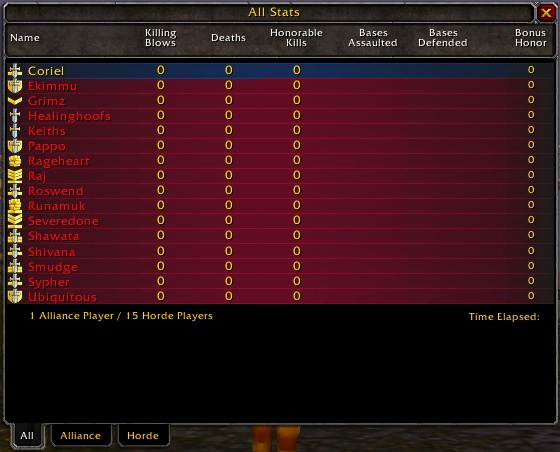
Analogy Update
From a thread in the WoW Raid & Dungeon forums.
Me:
Amelia (60 Priest):
/bow Amelia
Me:
Raiding is like playing in an orchestra. 5-man is like improvising jazz.
Amelia (60 Priest):
I think you badly overstate the skill required to do either of these things...more accurately:
"Raiding is like playing in a middle school marching band, 5-man is like open mike night at your local karaoke bar."
/bow Amelia
Thursday, March 16, 2006
Difference Between Casuals and Hardcore
In a comment, Maybe offers the following reason on why the hardcore "deserve" epic loot:
I disagree with the idea that a casual player would not be willing to come to wipe after wipe. I think that this is a common misconception on the part of the hardcore. In fact, a lot of casual players would be more willing to come to BWL than many so-called "raiders". You see this reflected in many posts on the WoW Raid & Dungeon forums. It's fairly common to see a post by a guild leader complaining that attendance for Blackwing Lair--with its many wipes and little loot--is much lower than attendance for Molten Core, which has few wipes and lots of loot.
Casual and hardcore are two ends of a spectrum. We all have elements of both casual and hardcore. Some people lean more towards one end or the other. In my view, the difference between a hardcore player and a casual player has to do with the process vs. reward outcome. A hardcore player aims for the "optimal" outcome regardless of the process, while a casual player will settle for a "good-enough" outcome if the process is interesting enough.
For example, take levelling. A hardcore player will try to get to 60 as fast as possible, even if it involves just grinding away on the same mob over and over. Grinding is the "optimal" way to get to 60. A casual player will quest, even if questing takes more time. Questing is "good-enough" for them because it is more interesting than grinding.
The same perspective carries over to gear. If a hardcore player decides that Blackhand Doomsaw is the "optimal" weapon, she will run Upper Blackrock Spire over and over, until she finally gets the Doomsaw. The casual player will probably acknowledge that the Doomsaw is the best weapon, but will be satisfied with his Bonecrusher. The Bonecrusher is "good-enough".
This also carries over to time spent in the game. The hardcore spend vast amounts of time, because that's necessary for the "optimal" outcome. Just look at the grind required to become Rank 14 in the PvP system. The casual player may spend one night a week playing WoW, because that's good enough for them. On that one night though, they'd be willing to come and wipe with the guild on Blackwing Lair.
Another example is Molten Core vs Zul'Gurub. A hardcore player is more likely to want to do MC, because the rewards are so great. A casual player would prefer to do ZG, because it's more interesting, even if the rewards are less powerful.
[Edit: I'm not sure the above paragraph is clear enough. I'm basing it on a personal experience. The guild I was in did a ZG run and an MC run each week, while learning each instance. The ZG run was stopped--even though people liked running ZG--in order to concentrate our efforts on mastering MC (ie multiple attempts, trash runs for materials for Fire Resistance gear, etc.). I do not think a casual guild would have made the same choice. I think they would have been more willing to accept slower progress in MC, but keep the ZG run as well. I don't think the decision to stop ZG was necessarily wrong (we did spawn Ragnaros in 3 weeks) but it was a "hardcore" decision.]
A casual player who is in a raid guild will come to Blackwing Lair wipes (maybe not every night of the week, but whenever they play). The process is interesting enough. A lot of hardcore players will also come, because the rewards are so great. The problem lies in getting the casual player to join the raiding guild. The rewards are great, but the process seems so much more of a hassle than non-raiding content.
A casual player is not less willing to raid (and wipe) than a hardcore player. However, a casual player is less willing to join a raiding guild than the hardcore player. This may seem like the same thing, but I think there is a subtle and important difference. In my opinion, Blizzard would be best served to cutting down the barriers that keep casual guilds from raiding.
However, if your guild is entering a new instance like BWL, and nobody in the guild has been there before, then that is a different story. My guild took 2 months to figure out how to down the first boss of BWL (even after reading all the strats online). That's 2 months of 40 people coming to the instance week after week knowing that they will probably wipe a bunch of times each night, getting no loot or gold in the process and having to spend their own gold on repairs (which can be quite substantial). That kind of dedication defines a "hardcore" player, and I think deserves epic rewards.
I disagree with the idea that a casual player would not be willing to come to wipe after wipe. I think that this is a common misconception on the part of the hardcore. In fact, a lot of casual players would be more willing to come to BWL than many so-called "raiders". You see this reflected in many posts on the WoW Raid & Dungeon forums. It's fairly common to see a post by a guild leader complaining that attendance for Blackwing Lair--with its many wipes and little loot--is much lower than attendance for Molten Core, which has few wipes and lots of loot.
Casual and hardcore are two ends of a spectrum. We all have elements of both casual and hardcore. Some people lean more towards one end or the other. In my view, the difference between a hardcore player and a casual player has to do with the process vs. reward outcome. A hardcore player aims for the "optimal" outcome regardless of the process, while a casual player will settle for a "good-enough" outcome if the process is interesting enough.
For example, take levelling. A hardcore player will try to get to 60 as fast as possible, even if it involves just grinding away on the same mob over and over. Grinding is the "optimal" way to get to 60. A casual player will quest, even if questing takes more time. Questing is "good-enough" for them because it is more interesting than grinding.
The same perspective carries over to gear. If a hardcore player decides that Blackhand Doomsaw is the "optimal" weapon, she will run Upper Blackrock Spire over and over, until she finally gets the Doomsaw. The casual player will probably acknowledge that the Doomsaw is the best weapon, but will be satisfied with his Bonecrusher. The Bonecrusher is "good-enough".
This also carries over to time spent in the game. The hardcore spend vast amounts of time, because that's necessary for the "optimal" outcome. Just look at the grind required to become Rank 14 in the PvP system. The casual player may spend one night a week playing WoW, because that's good enough for them. On that one night though, they'd be willing to come and wipe with the guild on Blackwing Lair.
Another example is Molten Core vs Zul'Gurub. A hardcore player is more likely to want to do MC, because the rewards are so great. A casual player would prefer to do ZG, because it's more interesting, even if the rewards are less powerful.
[Edit: I'm not sure the above paragraph is clear enough. I'm basing it on a personal experience. The guild I was in did a ZG run and an MC run each week, while learning each instance. The ZG run was stopped--even though people liked running ZG--in order to concentrate our efforts on mastering MC (ie multiple attempts, trash runs for materials for Fire Resistance gear, etc.). I do not think a casual guild would have made the same choice. I think they would have been more willing to accept slower progress in MC, but keep the ZG run as well. I don't think the decision to stop ZG was necessarily wrong (we did spawn Ragnaros in 3 weeks) but it was a "hardcore" decision.]
A casual player who is in a raid guild will come to Blackwing Lair wipes (maybe not every night of the week, but whenever they play). The process is interesting enough. A lot of hardcore players will also come, because the rewards are so great. The problem lies in getting the casual player to join the raiding guild. The rewards are great, but the process seems so much more of a hassle than non-raiding content.
A casual player is not less willing to raid (and wipe) than a hardcore player. However, a casual player is less willing to join a raiding guild than the hardcore player. This may seem like the same thing, but I think there is a subtle and important difference. In my opinion, Blizzard would be best served to cutting down the barriers that keep casual guilds from raiding.
Monday, March 13, 2006
Casuals vs. Raiders, Part II
There was a post on the WoW forums where someone asked the question "Why do people raid?". In large part because of Scholo/Strath raids, a lot of casual players simply don't think that 40-man raids can be challenging. After all, people raid Scholomance with 10 raiders because it is easier than going with 5 players. If 10 people is easier than 5, surely 40 is easier than 10. There are also few raid-style fights in 5-man. In my opinion, you really don't understand what the attraction of raiding is until you actually try one. The only real attraction a casual player sees is that raiders get epic loot.
Raiding is like solving a puzzle. The attraction of raiding lies in figuring out the puzzle, coming up with a strategy, and executing that strategy with a large number of people. It does require skills, but different skills than a 5-man does. A 5-man is more in the moment, more about anticipating and reacting to unexpected events.
Raiding is like playing in an orchestra. 5-man is like improvising jazz. Both require skill, but the skills required are different.
Of course the question then becomes: why do raids deserve epic loot, and 5-mans do not? The answer is that raids are not necessarily harder than 5-mans, but they can be more intricate. To go back to the music analogy, with a saxophone you can do a lot of crazy things while improvising jazz, but you simply cannot have a violin solo in the middle as you don't have a violin. Similarily, you cannot make a 5-man fight that lasts longer than one healer's mana bar. You cannot count on there being more than one healer in the group. But a raid fight can be arbitrarily long, thanks to the existence of healing rotations, where one healer regenerates mana while another heals, with a switch when a healer runs out of mana.
However, I do think that WoW overly rewards raiders, at the expense of casual players. Molten Core is a bit too easy or simple for the quality and quantity of rewards that it gives out. However, Blizzard seems to be making an effort to improve the imbalance in 1.10, increasing the quality of rewards available from 5-man dungeons.
Raiding is like solving a puzzle. The attraction of raiding lies in figuring out the puzzle, coming up with a strategy, and executing that strategy with a large number of people. It does require skills, but different skills than a 5-man does. A 5-man is more in the moment, more about anticipating and reacting to unexpected events.
Raiding is like playing in an orchestra. 5-man is like improvising jazz. Both require skill, but the skills required are different.
Of course the question then becomes: why do raids deserve epic loot, and 5-mans do not? The answer is that raids are not necessarily harder than 5-mans, but they can be more intricate. To go back to the music analogy, with a saxophone you can do a lot of crazy things while improvising jazz, but you simply cannot have a violin solo in the middle as you don't have a violin. Similarily, you cannot make a 5-man fight that lasts longer than one healer's mana bar. You cannot count on there being more than one healer in the group. But a raid fight can be arbitrarily long, thanks to the existence of healing rotations, where one healer regenerates mana while another heals, with a switch when a healer runs out of mana.
However, I do think that WoW overly rewards raiders, at the expense of casual players. Molten Core is a bit too easy or simple for the quality and quantity of rewards that it gives out. However, Blizzard seems to be making an effort to improve the imbalance in 1.10, increasing the quality of rewards available from 5-man dungeons.
Thursday, March 09, 2006
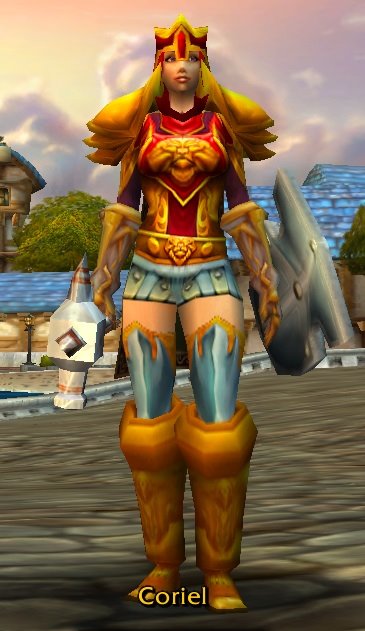
Friday, March 03, 2006
Upcoming Dungeon Changes
Heh, the day after I post about raiding the 5-man instances, Blizzard puts up the test patch notes for 1.10. Of special interest is the following:
Good work, Blizzard. With this move, Blizzard corrected a huge mistake, and made end game a whole lot more appealing. I seriously doubted that Blizzard would make such a big change with the expansion coming in a few months. I am really glad to see I was wrong.
Along with the new Armor Sets, the high-level 5-10 man dungeons have received some changes regarding loot. Many items have been improved in quality and use. In addition, several epic items, such as Headmaster's Charge and the Runeblade of Baron Rivendare, have had their drop rates significantly increased. In order to preserve the challenge of these dungeons, they have had their instance caps lowered. Stratholme, Scholomance, and Blackrock Depths now allow a maximum of five players inside, and Blackrock Spire allows a maximum of ten. [Emphasis mine]
Good work, Blizzard. With this move, Blizzard corrected a huge mistake, and made end game a whole lot more appealing. I seriously doubted that Blizzard would make such a big change with the expansion coming in a few months. I am really glad to see I was wrong.
Wednesday, March 01, 2006
Casuals vs. Raiders, Part I
There is a lot of debate and acrimony over casuals versus raiders in WoW. "Casual" players feel that Blizzard inordinately caters to the raiding players, rewarding them with better gear and interesting content. Raiding players, meanwhile, think that casual players just want epics handed to them, and are unwilling to put in the work. As someone who was a casual player for many months, before finally becoming a raider, I feel I have an interesting perspective on things.
Here are some points that I'd like to discuss:
1. Raiding looks harder than it is.
For a casual player, raiding is very intimidating. The raiding guilds force you to apply, almost like applying for a job. You hear horror stories of guilds expecting people to commit 12 hours a day. You can no longer just log on and do stuff. Instead, activities are formally scheduled. You don't get loot in a run, instead earning DKP which you exchange in some fashion for loot. The system used to give out DKP can be insanely baroque. The guild may demand that you spec a certain way, or play your character in an very specific way. You may be forced to download and install mods and accessories such as Teamspeak. The attitude of some raiding guilds is also very arrogant, as if Molten Core is incredibly hard, and you have to be an awesome player to even think of going inside.
Here's a big secret: raiding is not that hard. You go in, and you do what you've always done. If you can follow orders, you can raid. Most raiding guilds don't raid that much, and usually only in 3-5 hour increments. Molten Core is not very hard. If you can 5-man the endgame instances like Scholomance, Stratholme, and Dire Maul, you're more than competent enough to handle Molten Core. Raiding is not really about raw skill, it's about strategy. Coming up with the correct strategy for the raid as a whole, and then executing it well are the key points of raiding.
Scheduled runs are also more beneficial to the casual player than you think. If you know that MC is on Thursday nights, you can clear your schedule on that night. A hardcore player, on the other hand, is always online and really has no schedule to clear.
A lot of the problems with raiding stem from the player base. In many ways, raiders are extremely conservative in their approach. They are often unwilling to consider doing something in a different manner than the "established" strategy. You first encounter this when raiding Scholomance, etc. Often times, people looking for Scholo raids will demand a very precise make-up of the raid. You *must* have two priests, you *need* a mage, etc. Newsflash: You're already going in with twice as much firepower as you need. As long as you have the basics covered (tank, healer, dps), you'll probably do just fine.
Similarly, you don't need mods. Decursive is just laziness. The global cooldown gives you more than enough time to manually select your next target to be cleansed. CT_RaidAssist is nice, but is not really absolutely necessary. But the conservative nature of a lot of raiders insists that such extras be download and used.
Personally, I think that if casual players just gather enough courage to apply to the raiding guilds--especially ones that are just starting out--I think that they will find that they can raid just as well as the hardcore players. They may not be able to make every single raid that the guild does, but they will be more than able to contribute, see all the cool content in WoW, and get epic loot.
2. Raiding Scholo, Strath, etc. is an aberration.
I think the ability to raid a 5-man instance is a mistake for WoW. If the 5-mans were capped, people would be forced to do the instances properly. They would learn the skills appropriately, and be able to complete quests. The endgame content would last much longer, and you could properly bridge to the raiding content. I've been a 60 for months, and I still have a ton of unfinished quests.
In addition, I think the "raids" are a bad introduction to raiding in general. They really bring out the "loot" side in people. People raid just to get loot. These small raids aren't that fun, and are very easy. Real raid instances are more interesting and challenging. One of the great joys in raiding is having a plan and executing it well, something which is just not present in a Strath/Scholo raid. Instead it's pretty much pure firepower.
So a casual player who gets to 60 has a very distorted idea of what raiding is like. Small raids are an aberration, that really hurts the casual player's view of the end game in WoW.
3. Converting a casual guild to a raiding guild is hard.
A teaser for my next post. :)
Here are some points that I'd like to discuss:
1. Raiding looks harder than it is.
For a casual player, raiding is very intimidating. The raiding guilds force you to apply, almost like applying for a job. You hear horror stories of guilds expecting people to commit 12 hours a day. You can no longer just log on and do stuff. Instead, activities are formally scheduled. You don't get loot in a run, instead earning DKP which you exchange in some fashion for loot. The system used to give out DKP can be insanely baroque. The guild may demand that you spec a certain way, or play your character in an very specific way. You may be forced to download and install mods and accessories such as Teamspeak. The attitude of some raiding guilds is also very arrogant, as if Molten Core is incredibly hard, and you have to be an awesome player to even think of going inside.
Here's a big secret: raiding is not that hard. You go in, and you do what you've always done. If you can follow orders, you can raid. Most raiding guilds don't raid that much, and usually only in 3-5 hour increments. Molten Core is not very hard. If you can 5-man the endgame instances like Scholomance, Stratholme, and Dire Maul, you're more than competent enough to handle Molten Core. Raiding is not really about raw skill, it's about strategy. Coming up with the correct strategy for the raid as a whole, and then executing it well are the key points of raiding.
Scheduled runs are also more beneficial to the casual player than you think. If you know that MC is on Thursday nights, you can clear your schedule on that night. A hardcore player, on the other hand, is always online and really has no schedule to clear.
A lot of the problems with raiding stem from the player base. In many ways, raiders are extremely conservative in their approach. They are often unwilling to consider doing something in a different manner than the "established" strategy. You first encounter this when raiding Scholomance, etc. Often times, people looking for Scholo raids will demand a very precise make-up of the raid. You *must* have two priests, you *need* a mage, etc. Newsflash: You're already going in with twice as much firepower as you need. As long as you have the basics covered (tank, healer, dps), you'll probably do just fine.
Similarly, you don't need mods. Decursive is just laziness. The global cooldown gives you more than enough time to manually select your next target to be cleansed. CT_RaidAssist is nice, but is not really absolutely necessary. But the conservative nature of a lot of raiders insists that such extras be download and used.
Personally, I think that if casual players just gather enough courage to apply to the raiding guilds--especially ones that are just starting out--I think that they will find that they can raid just as well as the hardcore players. They may not be able to make every single raid that the guild does, but they will be more than able to contribute, see all the cool content in WoW, and get epic loot.
2. Raiding Scholo, Strath, etc. is an aberration.
I think the ability to raid a 5-man instance is a mistake for WoW. If the 5-mans were capped, people would be forced to do the instances properly. They would learn the skills appropriately, and be able to complete quests. The endgame content would last much longer, and you could properly bridge to the raiding content. I've been a 60 for months, and I still have a ton of unfinished quests.
In addition, I think the "raids" are a bad introduction to raiding in general. They really bring out the "loot" side in people. People raid just to get loot. These small raids aren't that fun, and are very easy. Real raid instances are more interesting and challenging. One of the great joys in raiding is having a plan and executing it well, something which is just not present in a Strath/Scholo raid. Instead it's pretty much pure firepower.
So a casual player who gets to 60 has a very distorted idea of what raiding is like. Small raids are an aberration, that really hurts the casual player's view of the end game in WoW.
3. Converting a casual guild to a raiding guild is hard.
A teaser for my next post. :)
Monday, February 27, 2006
Continuing Adventures in Molten Core
On Friday, our raid killed Gehennas, at which point I volunteered to leave the raid so another person could go. The guild continued on and dropped Garr, Baron Geddon, and Shazzrah. Saturday, I rejoined the raid and we attempted Golemagg. We had a bit of trouble with the trash mobs leading to Golemagg, and we ended up wiping three times on Golemagg before calling it a night.
Sunday, we tried Golemagg again, this time with 8 paladins! For some reasons, the paladins show up for all the raids, unlike a lot of other classes. We wiped again, and then we tweaked our strategy a little, assigning paladins to specifically heal the off-tanks, instead of healing everyone. This time the fight was smooth and we killed him easily. We moved on to Sulfuron, but we have trouble with people disconnecting and then having to wait in the queue. We did attempt Sulfuron 3 times, but on the third try, some of the trash mobs respawned in the middle of the fight. The raid was basically called, and we decided to take Monday off, and restart the instance on Thursday.
Still, taking down 7 bosses on our first MC run is a pretty good accomplishment. I think we are beginning to reach the limits of our gear, though, and another couple of weeks just to gear up with epics would probably help a lot. I still don't have any epics from the Core, though I do have a lot of DKP. Just waiting for Paladin gear to actually drop.
I did try out some of the options in CT_RaidAssist. The amount of effort people put into automating these fights amuses me. Automatic Decursing of the raid is standard. I was playing with Mana Conserve, which checks the target's health 0.5s before the healing spell finishes casting, and cancels the spell if the target's health is too high. It's somewhat useful, as I did end up cancelling two or three spells a fight.
Sunday, we tried Golemagg again, this time with 8 paladins! For some reasons, the paladins show up for all the raids, unlike a lot of other classes. We wiped again, and then we tweaked our strategy a little, assigning paladins to specifically heal the off-tanks, instead of healing everyone. This time the fight was smooth and we killed him easily. We moved on to Sulfuron, but we have trouble with people disconnecting and then having to wait in the queue. We did attempt Sulfuron 3 times, but on the third try, some of the trash mobs respawned in the middle of the fight. The raid was basically called, and we decided to take Monday off, and restart the instance on Thursday.
Still, taking down 7 bosses on our first MC run is a pretty good accomplishment. I think we are beginning to reach the limits of our gear, though, and another couple of weeks just to gear up with epics would probably help a lot. I still don't have any epics from the Core, though I do have a lot of DKP. Just waiting for Paladin gear to actually drop.
I did try out some of the options in CT_RaidAssist. The amount of effort people put into automating these fights amuses me. Automatic Decursing of the raid is standard. I was playing with Mana Conserve, which checks the target's health 0.5s before the healing spell finishes casting, and cancels the spell if the target's health is too high. It's somewhat useful, as I did end up cancelling two or three spells a fight.
Saturday, February 25, 2006
Paladin Tanking Idea: Guard
Eyonix, one of the Customer Managers at Blizzard, mentioned on the paladin boards that Blizzard is looking at ways to improve Paladin tanking. One of their goals, however, is specifically NOT to give paladins a Taunt-like ability. So there are now many posts on the boards tossing out different ideas. Here's mine, reposted for fun:
Here's an idea for tanking (sort of) that I think is reasonably different from warrior tanking, but is still flavourful for paladins.
Every paladin at level 10 gets a passive ability called Guard.
Guard
If the paladin is in front of the enemy, [melee] attacks made against a party member have a 50% chance of hitting the paladin instead.
Basically, the paladin can't force the mob to attack her, but she can put herself between the mob and her ally. This keeps the other person alive longer, and hopefully gives the paladin enough to time to truely regain aggro. It requires positioning, and since the mob isn't attacking the paladin, she can't "walk" it away or similar.
Then in the Protection tree we can have:
Improved Guard (5 pts)
Requires 0 points in Protection
Improves the paladin's chance to Guard a party member by 5/10/15/20/25%.
Frustrate (1 pt)
Requires 20 points in Protection
If the paladin successfully Guards a party member, has a 25% chance of forcing the enemy to attack the paladin for 6s.
Basically, deep in the protection tree, the paladin gets a kind of taunt. It's not very good, but relies on using the Guard mechanic. Plus the flavor is very obvious: "Stupid paladin blocking my attacks. Die Paladin!"
Perfect Defender (1 pt)
Requires Frustrate, 30 points in Protection
100 mana, 10s duration, 2 min cooldown
Increases the paladin's chance to Guard a party member by 25%. In addition, the first time the paladin successfully Guards a party member, the enemy is forced to attack the paladin for 6s.
This gives you pretty close to a guaranteed Taunt. You still have to do it through the Guard mechanics, so it's not as good/versatile as a true Taunt.
As well, the Guard mechanic would give us an added dimension in PvP. It doesn't seem likely that we are going to get any damage anytime soon, but we could use Guard to protect mages and priests, as we are supposed to do.
One more thing I'd like to mention is that I feel it is important for mechanics to 'fit' the class as much as possible. Divine Intervention is a terrible, terrible mechanic. You can only cast it on another person, who must be a resser AND in a position where she won't draw aggro when the fight ends. Compare that to the Warlock soulstone, or Shaman self-res. And yet the flavour of Divine Intervention--the paladin sacrificing herself to save her companion--is so strong, that the spell somehow works.
Hopefully this idea fits the flavour and 'sense' of being a paladin.
Here's an idea for tanking (sort of) that I think is reasonably different from warrior tanking, but is still flavourful for paladins.
Every paladin at level 10 gets a passive ability called Guard.
Guard
If the paladin is in front of the enemy, [melee] attacks made against a party member have a 50% chance of hitting the paladin instead.
Basically, the paladin can't force the mob to attack her, but she can put herself between the mob and her ally. This keeps the other person alive longer, and hopefully gives the paladin enough to time to truely regain aggro. It requires positioning, and since the mob isn't attacking the paladin, she can't "walk" it away or similar.
Then in the Protection tree we can have:
Improved Guard (5 pts)
Requires 0 points in Protection
Improves the paladin's chance to Guard a party member by 5/10/15/20/25%.
Frustrate (1 pt)
Requires 20 points in Protection
If the paladin successfully Guards a party member, has a 25% chance of forcing the enemy to attack the paladin for 6s.
Basically, deep in the protection tree, the paladin gets a kind of taunt. It's not very good, but relies on using the Guard mechanic. Plus the flavor is very obvious: "Stupid paladin blocking my attacks. Die Paladin!"
Perfect Defender (1 pt)
Requires Frustrate, 30 points in Protection
100 mana, 10s duration, 2 min cooldown
Increases the paladin's chance to Guard a party member by 25%. In addition, the first time the paladin successfully Guards a party member, the enemy is forced to attack the paladin for 6s.
This gives you pretty close to a guaranteed Taunt. You still have to do it through the Guard mechanics, so it's not as good/versatile as a true Taunt.
As well, the Guard mechanic would give us an added dimension in PvP. It doesn't seem likely that we are going to get any damage anytime soon, but we could use Guard to protect mages and priests, as we are supposed to do.
One more thing I'd like to mention is that I feel it is important for mechanics to 'fit' the class as much as possible. Divine Intervention is a terrible, terrible mechanic. You can only cast it on another person, who must be a resser AND in a position where she won't draw aggro when the fight ends. Compare that to the Warlock soulstone, or Shaman self-res. And yet the flavour of Divine Intervention--the paladin sacrificing herself to save her companion--is so strong, that the spell somehow works.
Hopefully this idea fits the flavour and 'sense' of being a paladin.
Thursday, February 23, 2006
First time in Molten Core
I joined a raiding guild on Eitrigg last week. Over the weekend we went to Zul'Gurub and killed Venoxsis (Snake) and Jeklik (Bat). They later killed Broodlord Mandokir, though I did not attend that raid. Today we went to Molten Core for the first time. We killed Lucifron and Magmadar, and then called it a night.
We wiped twice, once on a Core Hound pack, before we really understood the strategy behind them, and once on Magmadar, when a druid accidentally held down the forward key and charged him.
I didn't get any loot, though some good blues and epics dropped. Ah well, I'm accumulating DKP, so I'll eventually get some.
I like ZG more than Molten Core so far. The colour scheme in MC is very drab, all reds and browns. As well, the fights in ZG just seem so much cooler, much more puzzle-like and complicated. It could also be that I had twice as many health bars covering my screen, so I didn't actually get to see much of the event. To be honest, I'm not really sure what Lucifron even looks like.
Raiding as a paladin, well, it kind of sucks in some ways, actually. Every fiber of my being calls for me to be in the front lines, swinging my hammer. Instead, I'm standing at range, spamming Flash of Light and cleansing. Joy. Important jobs, I'll grant, but not what I made this character to do. There is a great sense of satisfaction in working as a team, though. All parts working together, executing well, and accomplishing a large goal as a group.
Still, the best part of the raid was when Magmadar dropped to 10%, and our Paladin captain ordered us to fling Hammers of Wrath at the big dog. Ahh, Hammer of Wrath. Still the best change to the paladin class ever!
We wiped twice, once on a Core Hound pack, before we really understood the strategy behind them, and once on Magmadar, when a druid accidentally held down the forward key and charged him.
I didn't get any loot, though some good blues and epics dropped. Ah well, I'm accumulating DKP, so I'll eventually get some.
I like ZG more than Molten Core so far. The colour scheme in MC is very drab, all reds and browns. As well, the fights in ZG just seem so much cooler, much more puzzle-like and complicated. It could also be that I had twice as many health bars covering my screen, so I didn't actually get to see much of the event. To be honest, I'm not really sure what Lucifron even looks like.
Raiding as a paladin, well, it kind of sucks in some ways, actually. Every fiber of my being calls for me to be in the front lines, swinging my hammer. Instead, I'm standing at range, spamming Flash of Light and cleansing. Joy. Important jobs, I'll grant, but not what I made this character to do. There is a great sense of satisfaction in working as a team, though. All parts working together, executing well, and accomplishing a large goal as a group.
Still, the best part of the raid was when Magmadar dropped to 10%, and our Paladin captain ordered us to fling Hammers of Wrath at the big dog. Ahh, Hammer of Wrath. Still the best change to the paladin class ever!
Thursday, February 16, 2006
Quote about Paladins
My post however is not to complain about being kicked from the raid but to inform the rest of the alliance on Eitrigg what fvcking retards these people are. They took 3-5 minute breaks in between every pull, instead of pulling the guys from Drak's room across the bridge, they all fought on the bridge, even after people got knocked off, there were no druids in the group, 2 priests and a bunch of paladins who thought they could melee [Emphasis mine], and instead of healing, the priests were too occupied with MC'ing the guards and throwing them off of the bridge. They also distributed every BoE loot as soon as it dropped, rather then doing them all at the same time at the end of the raid. Yea, like I said, noobs.
- Jurandrese, 60 Warrior, Officer of the end-game guild Epicus Furor on Etrigg
Look Blizzard, when an officer of an end-game guild can call a melee hybrid a 'fvcking retard' for attempting to melee, I would suggest that there is a fundamental problem with the design of the class.
Monday, February 13, 2006
New Beginnings
The last couple of weeks have seen two significant changes for Coriel. First, I left my guild. Second, I left my server.
(I also respecced to 0/27/24, but that proved to be a horrible, horrible mistake. I respecced back to 20/0/31 as soon as I got enough gold.)
I'd been with my guild, Defender of the Crown, for a long time. Months, in fact. I joined as a level 10 paladin killing murlocs in Elwynn Forest. I was one of the first 60s in the guild, and spent a long time waiting for enough 60s to start raiding. Curiously, though, the start of regular raiding was what led me to quit the guild. The problem was that DotC was, in the end, a primarily Australian guild. We started raiding the 10-man instances regularly, but on Australian time, which was quite late for me. And the time difference just proved too hard to overcome.
I actually feel quite sad about leaving my guild. The people were really nice, and I have a lot of good memories.
Anyways, I was guildless, and just pvping occasionally and casually inquiring into joining a raiding guild, when Blizzard opened transfers from Bronzebeard to Eitrigg. I wasn't having much luck in finding a raiding guild (most guilds were full on paladins), and the queues were getting very long, so I jumped ship.
Now, I'm on Eitrigg, looking for a guild. In the meantime, I've been helping farm Silithid carapaces for the Ahn Qiraj sceptre questline. It's amusing, and is actually pretty good money if you skin.
I do want to write up a couple of posts. One on pvp and one on some end-game thoughts. Hopefully, I'll get to them sometime this week.
(I also respecced to 0/27/24, but that proved to be a horrible, horrible mistake. I respecced back to 20/0/31 as soon as I got enough gold.)
I'd been with my guild, Defender of the Crown, for a long time. Months, in fact. I joined as a level 10 paladin killing murlocs in Elwynn Forest. I was one of the first 60s in the guild, and spent a long time waiting for enough 60s to start raiding. Curiously, though, the start of regular raiding was what led me to quit the guild. The problem was that DotC was, in the end, a primarily Australian guild. We started raiding the 10-man instances regularly, but on Australian time, which was quite late for me. And the time difference just proved too hard to overcome.
I actually feel quite sad about leaving my guild. The people were really nice, and I have a lot of good memories.
Anyways, I was guildless, and just pvping occasionally and casually inquiring into joining a raiding guild, when Blizzard opened transfers from Bronzebeard to Eitrigg. I wasn't having much luck in finding a raiding guild (most guilds were full on paladins), and the queues were getting very long, so I jumped ship.
Now, I'm on Eitrigg, looking for a guild. In the meantime, I've been helping farm Silithid carapaces for the Ahn Qiraj sceptre questline. It's amusing, and is actually pretty good money if you skin.
I do want to write up a couple of posts. One on pvp and one on some end-game thoughts. Hopefully, I'll get to them sometime this week.
Thursday, February 02, 2006
Being Ganked in Towns
Alhough Coriel is on a PvE server, I started playing on a PvP server. I still maintain a couple of Horde alts on a PvP server which I play from time to time.
I do not engage in a lot of world PvP. Personally, I never saw much point in attacking someone who was lower level than you, and if she's higher than you, it's silly to attack as you're going to die. (The few times I have fought someone around my level were a lot of fun, though.) I don't really mind if someone ganks me as I'm adventuring. That's the price of being on a PvP server, and part of the fun.
What I do mind, however, is a 60 rogue de-cloaking inside one of my towns (Tarren Mill, Sun Rock Retreat, etc.) and killing me. Your towns should be a bit of a safe haven in the wilderness. Sure, there are guards, but they do nothing against sneaking rogues.
So what I propose is that the guards get dogs. Dogs which can scent the stealthed rogue and raise the alarm. This seems like a change that is in character for the game. Guard dogs make logical sense. Perhaps you could have a guard and dog patrol the town, forcing a stealthed rogue to time his movements to avoid the patrol.
(If, upon spotting the rogue, the dog went all Beastial Fury, I wouldn't complain. That would probably be excessive though.)
Guard Dogs. A change the towns in Azeroth need.
I do not engage in a lot of world PvP. Personally, I never saw much point in attacking someone who was lower level than you, and if she's higher than you, it's silly to attack as you're going to die. (The few times I have fought someone around my level were a lot of fun, though.) I don't really mind if someone ganks me as I'm adventuring. That's the price of being on a PvP server, and part of the fun.
What I do mind, however, is a 60 rogue de-cloaking inside one of my towns (Tarren Mill, Sun Rock Retreat, etc.) and killing me. Your towns should be a bit of a safe haven in the wilderness. Sure, there are guards, but they do nothing against sneaking rogues.
So what I propose is that the guards get dogs. Dogs which can scent the stealthed rogue and raise the alarm. This seems like a change that is in character for the game. Guard dogs make logical sense. Perhaps you could have a guard and dog patrol the town, forcing a stealthed rogue to time his movements to avoid the patrol.
(If, upon spotting the rogue, the dog went all Beastial Fury, I wouldn't complain. That would probably be excessive though.)
Guard Dogs. A change the towns in Azeroth need.
Theorycraft: +Spellcrit and +Healing
h = amount of +dmg or + heal
c = spell crit rate, 0 < c < 1
M= crit multiplier (usually 1.5 for spells)
p'(h) = rate of increase of power when adding +heal
For power of the spell (healing/second):
p(c,h) = [p(0,0) + Kh][1 + (M-1)c]
p'(h) = K[1 + (M -1)c] (constant)
p'(c) = [p(0,0) + Kh][M - 1] (constant)
where K = 2/7
For efficiency (without Illumination) (healing/mana):
e(c,h) = [e(0,0) + Lh][1 + (M - 1)c]
e'(h) = L[1 + (M-1)c] (constant)
e'(c) = [e(0,0) + Lh][M - 1] (constant)
where L = (2/7)*(SpellSpeed/SpellCost)
For efficiency (with Illumination) (healing/mana):
i(c,h) = [i(0,0) + Lh][ (1 + (M - 1)c)/(1 - c) ]
i'(h) = L[ [ (1 + (M-1)c)/(1 -c) ] ] (constant)
i'(c) = [i(0,0) + Lh][ M / ((1 - c)^2) ] (Exponential!!!)
Also note that i'(c) > e'(c)!
c = spell crit rate, 0 < c < 1
M= crit multiplier (usually 1.5 for spells)
p'(h) = rate of increase of power when adding +heal
For power of the spell (healing/second):
p(c,h) = [p(0,0) + Kh][1 + (M-1)c]
p'(h) = K[1 + (M -1)c] (constant)
p'(c) = [p(0,0) + Kh][M - 1] (constant)
where K = 2/7
For efficiency (without Illumination) (healing/mana):
e(c,h) = [e(0,0) + Lh][1 + (M - 1)c]
e'(h) = L[1 + (M-1)c] (constant)
e'(c) = [e(0,0) + Lh][M - 1] (constant)
where L = (2/7)*(SpellSpeed/SpellCost)
For efficiency (with Illumination) (healing/mana):
i(c,h) = [i(0,0) + Lh][ (1 + (M - 1)c)/(1 - c) ]
i'(h) = L[ [ (1 + (M-1)c)/(1 -c) ] ] (constant)
i'(c) = [i(0,0) + Lh][ M / ((1 - c)^2) ] (Exponential!!!)
Also note that i'(c) > e'(c)!
Subscribe to:
Posts (Atom)